
Scripture Library
The Tattvartha Sutra: The Scripture Jains Share
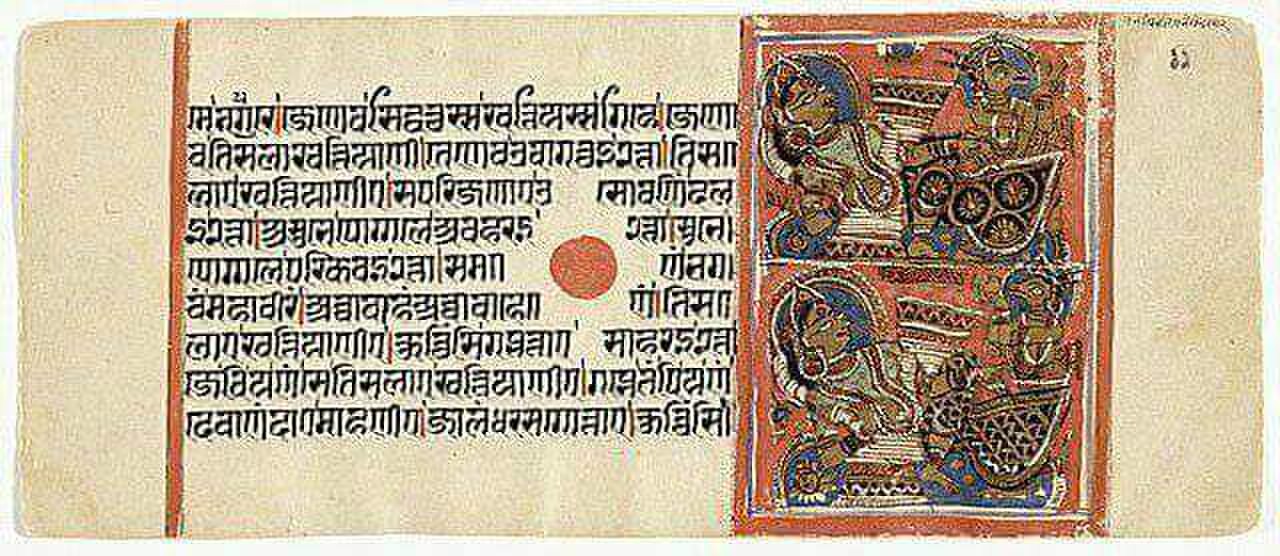
A reader's guide to Umasvati's Tattvartha Sutra, why both Digambara and Svetambara Jains accept it, how its ten chapters are organized, and which English translations to read.
Most religious traditions have a text everyone cites; fewer have a text everyone accepts. Jainism’s two major streams, Digambara and Svetambara, disagree about scripture at the deepest level. Digambaras hold that the original canon was lost, while Svetambaras preserve forty-five Prakrit scriptures redacted in the fifth century CE. Yet one work stands securely on both sides of that divide: the Tattvartha Sutra of Umasvati, a compact Sanskrit summary of the entire Jain path in roughly 350 aphorisms across ten chapters. Its importance in Jainism is often compared to that of the Yoga Sutras or Brahma Sutras in Hindu traditions. If you read one Jain text, most teachers , of either community, will point you here.
Who was Umasvati?
Almost everything about the author is contested except his achievement. He is generally placed between the second and fifth centuries CE. Svetambaras call him Umasvati, count him among their teachers, and hold that he wrote not only the sutras but their earliest commentary, the Svopajna Bhasya (“auto-commentary”). Digambaras call him Umasvami and place him in the lineage of the revered acharya Kundakunda, and hold that the auto-commentary is not his. Each community, in other words, claims the author and reads him through its own commentarial tradition: the Bhasya and Siddhasenagani’s sub-commentary on the Svetambara side, and Pujyapada’s Sarvarthasiddhi followed by Akalanka’s Tattvartharajavartika on the Digambara side. The two recensions of the text differ modestly , the Svetambara version is conventionally counted at 344 sutras, the Digambara at 357, with occasional differences in wording and numbering, but the doctrinal architecture is the same.
His choice of language was itself historic. Earlier Jain scriptures were composed in Prakrit vernaculars; the Tattvartha Sutra is the first major Jain work in Sanskrit, the shared scholarly language of classical India. The choice announced that Jain philosophy intended to argue its case in the common intellectual arena, and it worked, drawing commentaries, rebuttals, and engagement for fifteen centuries.
The famous first line
The text opens with a sutra many Jains know by heart: samyag-darsana-jnana-caritrani moksa-margah. “Right faith, right knowledge, and right conduct together constitute the path to liberation” (Tattvartha Sutra 1.1). The line does quiet but decisive work. Liberation requires all three jewels (ratnatraya) jointly , not belief alone, not learning alone, not discipline alone. Nathmal Tatia renders it: “The enlightened world-view, enlightened knowledge and enlightened conduct are the path to liberation.” The rest of the book is essentially a systematic unpacking of what those three terms require.
A map of the ten chapters
The Tattvartha Sutra reads less like scripture in the narrative sense and more like an engineer’s specification of reality. Its ten chapters proceed:
- Knowledge, how cognition works, the varieties of knowledge, and the standpoints (nayas) from which claims are made.
- The soul, the nature of jiva, classified by senses and states.
- The lower and middle worlds: Jain cosmology’s hells and human realms.
- The gods, the celestial beings and their grades.
- The non-living, matter, space, time, and the media of motion and rest.
- The inflow of karma, how activity draws karmic matter to the soul.
- The vows, the five vows and the lay and ascetic disciplines built on them.
- Bondage, how karma binds, its types and durations.
- Stoppage and shedding, restraint, the ten virtues, austerity: how influx is halted and old karma worn away.
- Liberation, the soul’s final release.
The order is the argument: understand what you are (1–5), understand what binds you (6–8), reverse it (9), and the result is moksha (10). Chapter 7 grounds the ethics we survey in the five great vows; chapter 9’s list of ten supreme virtues supplies the daily themes of the Digambara festival of Das Lakshana, during which the text is publicly recited.
Seven tattvas: the sutra’s skeleton
Early in chapter one, Umasvati lists the seven tattvas, the “reals” whose knowledge constitutes right understanding: the soul (jiva), the non-soul (ajiva), karmic inflow (asrava), bondage (bandha), stoppage (samvara), shedding (nirjara), and liberation (moksa) (Tattvartha Sutra 1.4). Digambara tradition often expands the list to nine categories by adding merit (punya) and demerit (papa). The seven function like a physician’s diagnosis: the condition, its cause, the cure, and health restored. Everything in Jain practice, vows, fasting, confession, meditation , maps onto stopping inflow and shedding what is already bound, a framework worth comparing with other traditions’ accounts of karma.
The verse a community wears
One sutra has escaped the book entirely. Parasparopagraho jivanam. “souls render service to one another” (Tattvartha Sutra 5.21) , has become the unofficial motto of modern Jainism, inscribed on the emblem adopted by Jain organizations worldwide. In context it states the function of souls in the cosmos; in use it condenses Jain ecology: every living being exists in a web of mutual support, so harm anywhere is harm to the web. That a technical treatise on ontology produced the tradition’s best-loved single line says something about the book’s standing.
Reading it in English
The standard scholarly entry point is Nathmal Tatia’s translation, “That Which Is” (HarperCollins, 1994; since reissued by Yale University Press in the Sacred Literature series). Tatia’s edition is unusual in printing the Svetambara and Digambara recensions together, noting where the traditions diverge, and distilling the major commentaries of both, making it not just a translation but a small course in how the two communities read one book differently. It includes an introduction to the Jain faith by the eminent scholar Padmanabh S. Jaini.
Older and freely available is J. L. Jaini’s “Tattvarthadhigama Sutra” (Sacred Books of the Jainas, Vol. 2, 1920), serviceable though dated in idiom. More recent devotional editions, such as Vijay Jain’s English rendering with the Sarvarthasiddhi commentary, serve readers who want the Digambara commentarial voice in full.
First-time readers should adjust expectations: sutra literature is deliberately compressed, written to be memorized and then expanded by a teacher. Read a chapter’s sutras straight through for the skeleton, then return with the commentary for the flesh; our general advice in how to read scripture applies here doubly. And do not skip the cosmological chapters as “unscientific” filler, for Umasvati, knowing the structure of the world and knowing how to act in it are one discipline. That refusal to separate metaphysics from ethics may be the most contemporary thing about this seventeen-century-old book.