
Scripture Library
The Guru Granth Sahib: How Sikh Scripture Is Organized and How to Approach It
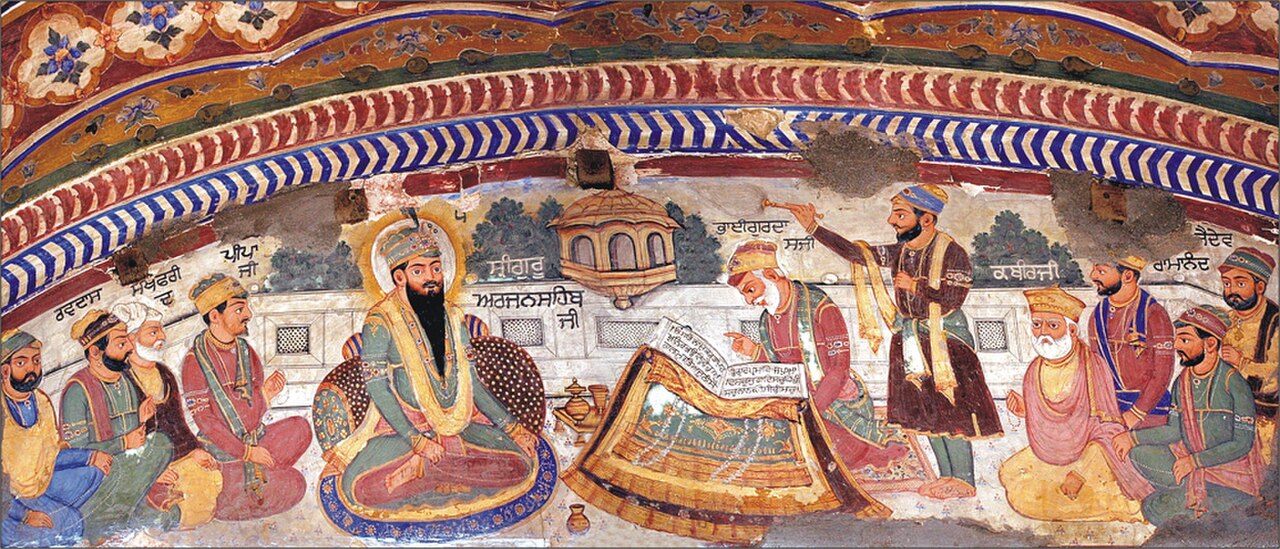
A reader's guide to the 1,430 angs of Sikh scripture, its compilation in 1604, its organization by 31 ragas, the six Gurus and the Bhagats whose voices it holds, and how to begin reading it in English.
Not a book about the Guru
The first thing to understand about the Guru Granth Sahib is what the name claims. This is not a book about the Sikh Gurus; for Sikhs it is the Guru, the living successor to ten human teachers. Tradition holds that in 1708 at Nanded, in present-day Maharashtra, the dying tenth Guru, Gobind Singh, declared that no human would succeed him: the scripture itself would be Guru from then on. Every convention that can puzzle a first-time visitor to a gurdwara , the canopy, the whisk, the bowing, the book’s nightly “rest”, follows from that single decision. Sikhs do not worship a book; they attend on a teacher.
That standing changes how the text is best approached, even by outsiders. You are not opening an anthology so much as visiting a court where some three dozen voices, gathered across five centuries of Indian devotional life, sing in one arrangement.
How it came to be
The core compilation is unusually well anchored in history. In 1603–1604 the fifth Guru, Arjan, working at Amritsar with the scholar Bhai Gurdas as his scribe, collected and edited the hymns of the first five Gurus together with the compositions of earlier saints, and had the volume, the Adi Granth, “first book” , formally installed in the newly built Harmandir Sahib (the Golden Temple) in 1604. The revered elder Baba Buddha was appointed its first granthi, or custodian-reader. Tradition adds a detail that foreshadowed everything: Guru Arjan gave the volume the raised seat and slept on the floor beside it.
A century later, Guru Gobind Singh prepared the final recension, traditionally at Damdama Sahib, around 1705–1706, dictating to the scribe Bhai Mani Singh adding the hymns of his father, the ninth Guru Tegh Bahadur. It is this Damdama version, standardized in print at 1,430 pages, that stands in every gurdwara today. Sikhs call the pages angs, “limbs,” because a Guru has a body, not pages; citations therefore read “Ang 1” rather than “page 1.”
The architecture of 1,430 angs
The volume opens with the Mul Mantar, the creedal formula beginning Ik Onkar. “One Creator” , explored word by word in our companion article. It flows directly into Japji Sahib (Angs 1–8), Guru Nanak’s thirty-eight-stanza meditation recited by observant Sikhs each morning, followed by a short section of evening prayers.
Then, from Ang 14 to Ang 1352, comes the immense central body of the scripture, organized not by author, topic, or chronology but by music. After the musical core, a closing section (Angs 1353–1430) gathers material that does not fit the raga scheme: Sanskrit-inflected verses, the saloks of Kabir and Farid, panegyrics by court bards (the Bhatts), and Guru Arjan’s Mundavani (Ang 1429), his “seal” on the volume, describing it as a platter holding three dishes: truth, contentment, and reflection. The final composition, the Ragmala (Ang 1430), a catalogue of ragas, has been the subject of long-running debate within the community over its authorship and status.
Thirty-one ragas
Each section of the central body is assigned to one of 31 ragas, melodic frameworks of North Indian music , beginning with Sri Raag and ending with Raag Jaijawanti. Within each raga, hymns are ordered by length and form (short shabads first, then longer ashtapadis, ballad-like vars, and other forms), and within each form by author.
The choice of music as the master key is not administrative but theological. These poems were composed to be sung. Guru Nanak sang while his Muslim companion Mardana played the rabab , and each raga carries an emotional climate: Asa’s hopeful dawn, Bilaval’s brightness, the monsoon longing of Malhar. Kirtan, the sung performance of these hymns in their prescribed ragas, is how most Sikhs actually absorb scripture; the printed ang is closer to a score than a chapter.
Authorship within the ragas is marked by the word Mahala plus a number. Mahala 1 for Guru Nanak, Mahala 3 for Guru Amar Das, Mahala 5 for Guru Arjan, and so on , a convention expressing the Sikh conviction that one light passed through successive bodies.
Six Gurus, and the radical guest list
Six of the ten Gurus have compositions in the Guru Granth Sahib: Nanak (974 hymns, by the common count), Angad (62 saloks), Amar Das (about 907 compositions), Ram Das (679, including the Lavan verses sung at Sikh weddings), Arjan (over 2,200, the largest share), and Tegh Bahadur (116 hymns and saloks, added in the final recension).
But the scripture’s most striking editorial decision is who else is inside. Guru Arjan included the works of fifteen Bhagats, devotional poets from outside the Sikh line, several of them from communities their society ranked lowest, and two of them Muslim:
- Kabir, the mystic weaver of Banaras, with over 500 compositions, the largest non-Guru voice.
- Sheikh Farid, the twelfth–thirteenth-century Punjabi Sufi of the Chishti order, whose saloks make the Guru Granth Sahib one of the earliest anthologies of Punjabi Muslim poetry.
- Namdev, the calico-printer saint of Maharashtra.
- Ravidas, the leather-worker of Banaras, whose hymn of the casteless city “Begampura”. “the town without sorrow” , sits on Ang 345.
Alongside them stand Trilochan, Beni, Dhanna, Jaidev, Parmanand, Pipa, Ramanand, Sadhna, Sain, Surdas, and Bhikhan, plus bards and minstrels of the Gurus’ court. A scripture compiled in a caste-ordered society deliberately seats a weaver, a cobbler, and a Sufi sheikh beside kings’ teachers, on equal musical terms. The guest list is the theology.
Gurmukhi, and the languages inside it
The Guru Granth Sahib is written in Gurmukhi: “from the mouth of the Guru” , the script standardized under the second Guru, Angad, and used for Punjabi to this day. But script and language are different things: within Gurmukhi letters, the scripture’s poetry moves among old Punjabi, the devotional lingua franca scholars call sant bhasha, Braj, and words drawn from Persian, Arabic, and Sanskrit, shifting register with each poet. Early manuscripts were written in continuous script without word breaks; the modern printed edition separates words, which is one reason the standard pagination could be fixed at exactly 1,430 angs.
How it is treated in a gurdwara
Because the volume is the Guru, it receives the honors of a sovereign. It presides from a cushioned stand beneath a canopy (the Palki Sahib), wrapped in embroidered rumala cloths, while an attendant waves the chaur whisk. Each morning it is ceremonially opened (prakash, “illumination”); each night it is closed and carried, on a cushion, on someone’s head , to a resting room in a ceremony called sukhasan. Anyone in its presence covers their head and sits lower than it does. On solemn occasions the community holds an Akhand Path: a complete, unbroken relay reading of all 1,430 angs, taking about forty-eight hours. Our visitor’s guide to the gurdwara walks through what all this looks like from the floor of the hall.
Approaching it in English
For non-Punjabi readers, the standard free access point is the English translation of Sant Singh Khalsa, searchable ang by ang on SikhiToTheMax and SriGranth.org, often displayed beside the Gurmukhi original and its transliteration. It is serviceable and complete, with caveats worth knowing: it is the work of a single translator, its diction is sometimes dated, and as with any rendering of mystical poetry , its interpretive choices harden ambiguities the original leaves open. Earlier efforts frame the problem: Ernest Trumpp’s hostile 1877 partial translation alienated the community, while Max Arthur Macauliffe’s sympathetic The Sikh Religion (1909) remains a readable public-domain classic. For the poetry itself, Nikky-Guninder Kaur Singh’s translations of selected hymns are widely admired.
A practical path for a newcomer: begin with Japji Sahib in two translations side by side; listen to a kirtan recording of a hymn while following the text; then sample the Bhagats. Farid’s austere saloks, Ravidas’s Begampura , to feel the anthology’s range. Read slowly and in small portions, as you would any scripture; our general piece on how to read scripture applies here with full force. However you come to it, as seeker, scholar, or curious neighbor , you are approaching what Sikhs regard as a living teacher, and the tradition’s own habit is a good guide for reading: sit low, listen first, and let the music carry the meaning.