
Shared Ideas
Vegetarianism Across Dharma Traditions: Four Reasons and Their Disagreements
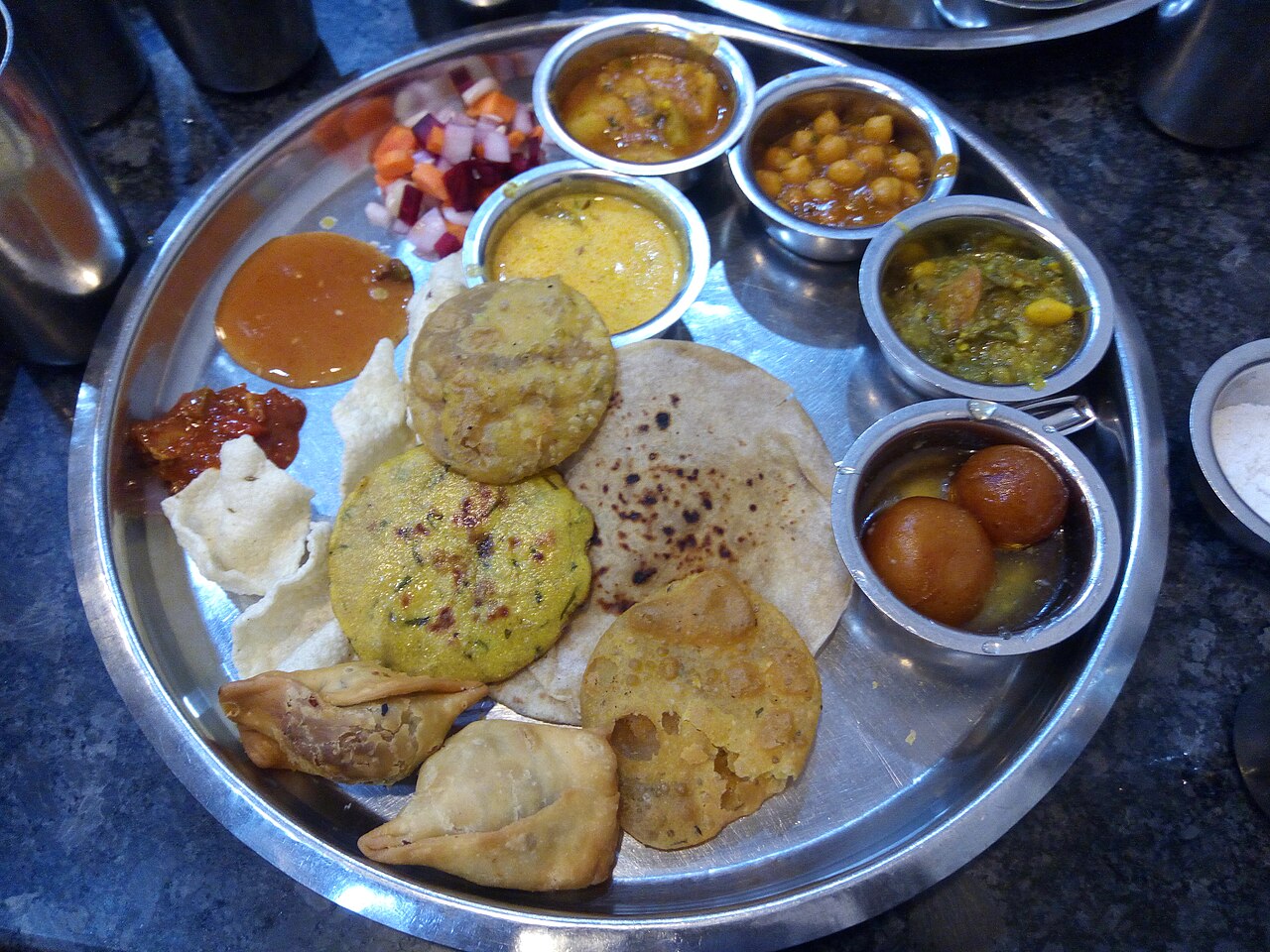
Why Hindu, Buddhist, Jain, and Sikh traditions avoid meat for different reasons, what Manu, the Pali canon, Jain lay codes, and Guru Nanak actually say, and where each tradition still argues.
Sometime in the third century BCE, the Mauryan emperor Ashoka had a notice carved into a boulder at Girnar, in present-day Gujarat, and on rock faces across his empire. After banning animal sacrifice, it turned to his own kitchen. “Formerly, in the kitchen of Beloved-of-the-Gods, King Piyadasi, hundreds of thousands of animals were killed every day to make curry,” the first rock edict reads in Ven. S. Dhammika’s rendering. “But now with the writing of this Dhamma edict only three creatures, two peacocks and a deer are killed, and the deer not always. And in time, not even these three creatures will be killed.”
A king who had embraced the Buddha’s teaching announced a direction and admitted he had not arrived. That pattern, a pull toward the vegetable plate combined with honest argument about how far to go, runs through all four Dharma traditions. What differs, sharply, is the reason. Each tradition gives a different account of what is wrong with meat, and those accounts produce different rules.
Manu’s argument with itself
The Hindu case is best seen in the fifth chapter of the Manusmriti, a legal text most scholars date to the early centuries CE. Often quoted as a vegetarian manifesto, it reads in sequence like a debate recorded inside one book.
First come the permissions. One may eat meat that has been consecrated in a rite, when Brahmins request it, or when one’s life is in danger (5.27). Animals, the text says, were created by the Self-existent for the sake of sacrifice, so killing in sacrifice “is not slaughtering” in the ordinary sense (5.39). The tone then turns. “Meat can never be obtained without injury to living creatures, and injury to sentient beings is detrimental to (the attainment of) heavenly bliss; let him therefore shun (the use of) meat” (5.48, trans. Bühler). Verse 5.51 spreads the guilt across the whole supply chain: the one who permits the killing, the butcher, the slaughterer, the seller, the buyer, the cook, the server, and the eater are all counted as slayers. Verse 5.55 adds a pun that became famous: mamsa, meat, is read as mam sa, “me he”, the animal whose flesh I eat here will eat me in the next world.
The chapter settles on a compromise, not a ban. “There is no sin in eating meat, in (drinking) spirituous liquor, and in carnal intercourse, for that is the natural way of created beings, but abstention brings great rewards” (5.56). Abstaining is meritorious; eating is not sinful. Vaishnava communities pushed toward the higher tier by treating every meal as an offering: in the Bhagavad Gita, Krishna accepts a leaf, a flower, a fruit, or water offered with devotion (9.26), and food offered to the deity returns as prasad, sanctified food, which in these communities is vegetarian. Other Hindu communities, from Bengal to Kashmir to the Konkan coast, kept fish or meat on the table without regarding themselves as less observant.
The Buddha’s bowl: killing versus eating
The early Buddhist position turns on a distinction that surprises many readers: the first precept forbids killing (panatipata), not eating. In the Jivaka Sutta (MN 55), set in the physician Jivaka’s mango grove at Rajagaha, the Buddha states that meat should not be accepted in three cases: when the monk has seen, heard, or suspects that the animal was killed for him. The same discourse turns hard on the supplier: whoever has a creature slaughtered to feed the Buddha or a disciple generates much demerit in five ways, from ordering it fetched to serving unallowable food.
The logic follows from early Buddhism’s location of karma in intention: a mendicant on alms round takes what is placed in the bowl and has no part in the decision to kill. When Devadatta proposed five stricter rules for the monastic community, one of them lifelong abstention from fish and meat, the Buddha declined to make it compulsory and restated the threefold test (Cullavagga VII, Vinaya ii 197). At the same time, a lay follower is told not to earn a living by trading in meat, one of five prohibited trades in the Vanijja Sutta (AN 5.177). Butchery is wrong livelihood; accepting a meal is not.
Mahayana Buddhism reopened the question. The eighth chapter of the Lankavatara Sutra rejects the threefold allowance outright and argues that, over countless rebirths, every creature has at some point been one’s mother, father, brother, sister, son, or daughter. In a footnote to his 1932 translation, D. T. Suzuki called the chapter a later addition to the text. In the early sixth century, Emperor Wu of the Liang dynasty pressed Chinese monks and nuns to give up meat, and monastic vegetarianism became the norm in China, Korea, and Vietnam. Theravada monastics in Sri Lanka and Southeast Asia still generally eat what they are given. On the Tibetan plateau, where crops were scarce, meat remained common, and the yogi Shabkar Tsogdruk Rangdrol (1781–1851) wrote forcefully against it in the collection now translated as Food of Bodhisattvas. All these communities share the five precepts; their menus differ.
Counting senses: the Jain calculus
Jain food ethics is less a rule about meat than a method for measuring harm. Jain thought sorts living beings by the number of senses they possess, from one-sensed plants and earth and water bodies up to five-sensed animals and humans. Every meal destroys some life; the task is to destroy the least, and the fewest higher beings.
Meat fails that test at once, since it requires killing a five-sensed creature, but the method reaches further than any other tradition’s rule. Medieval lay manuals list a set of basic restraints (mulagunas) for householders that include giving up meat, alcohol, and honey, the last because collecting it destroys bees, and they add five kinds of fig-like fruit thought to harbour many small organisms. Many observant Jains also avoid root vegetables, which are classed as anantakaya, bodies hosting countless one-sensed souls, and eat before sunset to avoid harming insects that are hard to see after dark. Our piece on Jain food follows these rules into the modern kitchen. The comparative point is that Jain restraint scales: the arithmetic that excludes meat also treats a carrot as costlier than a grain of rice.
“Fools argue about flesh”: the Sikh debate
Sikh teaching approaches diet with suspicion of ritual purity itself. A salok of Guru Nanak in the Var of Rag Malar includes the line: “The fools argue about flesh and meat, but they know nothing about meditation and spiritual wisdom” (Ang 1289, trans. Sant Singh Khalsa). The passage goes on to note that humans are themselves conceived in flesh, and that the gods of ancient ritual feasted on animal offerings. Its target is dietary purity used as a substitute for devotion.
How to apply that verse is a live disagreement within the Panth. The Sikh Rehat Maryada, the code of conduct issued under the Shiromani Gurdwara Parbandhak Committee, lists eating kutha meat among the four major transgressions forbidden to initiated Sikhs. The common reading takes kutha to mean meat from an animal slaughtered by the Islamic ritual method, which leaves meat killed with a single stroke (jhatka) permissible. Other groups, including the Akhand Kirtani Jatha and the Namdharis, hold that initiated Sikhs should not eat meat at all, and they cite verses such as a salok of Bhagat Kabir (Ang 1377) that condemns those who consume cannabis, fish, and wine whatever pilgrimages or fasts they keep. Both sides claim Guru Nanak’s salok: one reads it as a rebuke to vegetarian pedantry, the other as a rebuke to all pedantry, with no endorsement of meat.
The langar served in gurdwaras is lacto-vegetarian, so that no guest’s dietary rule keeps them from sitting in the same row as everyone else.
Not “Indian religions are vegetarian”
The common misreading runs in two directions. Outsiders often assume that Hindus, Buddhists, Jains, and Sikhs are vegetarian by definition; some insiders assume that eating meat means departing from scripture. Manu declares meat-eating not sinful while praising abstention. The Buddha refused to make vegetarianism a monastic rule. Guru Nanak ridiculed arguments over flesh. Only the Jain tradition makes abstention from meat a baseline obligation for every member, and even there the debate concerns how much further to go.
A related misreading concerns the Bhagavad Gita. Its seventeenth chapter sorts foods by the three gunas, qualities of nature: sattvic foods promote life, strength, and health; tamasic foods are stale, putrid, left over, or impure (17.8–10). The verses themselves name no meat. Classifying meat as tamasic, often by reading “impure” (amedhya) to include it, is a later interpretation widely held in Vaishnava communities rather than something the text states.
Finally, “vegetarian” in Indian usage normally includes milk, ghee, and yoghurt and excludes eggs, which is why a langar or a Jain meal contains dairy but no egg.
Eating with others
If you are hosting guests from these traditions, the safest default is the langar’s: a lacto-vegetarian meal without eggs, with onion, garlic, and root vegetables kept in separate dishes for stricter Jain or Vaishnava guests. Ask rather than assume; a Bengali Hindu friend may be delighted by fish, and a Theravada Buddhist colleague may eat chicken without breaking any precept.
If you are weighing the question for yourself, the four traditions offer four distinct tests. Manu asks whether you can accept the whole chain from slaughter to plate. The Buddha asks whether the animal died on your account. The Jain teacher asks how many lives, and of what kind, this meal costs. Guru Nanak asks whether your attention to food has crowded out attention to God. The principle underneath all four, discussed in our overview of ahimsa, is the same. Ashoka’s two peacocks and a deer, still on the menu when the edict was carved, suggest that these traditions have long valued an honest direction over instant perfection.