
Jainism
Anekantavada: The Jain Doctrine of Many-Sidedness
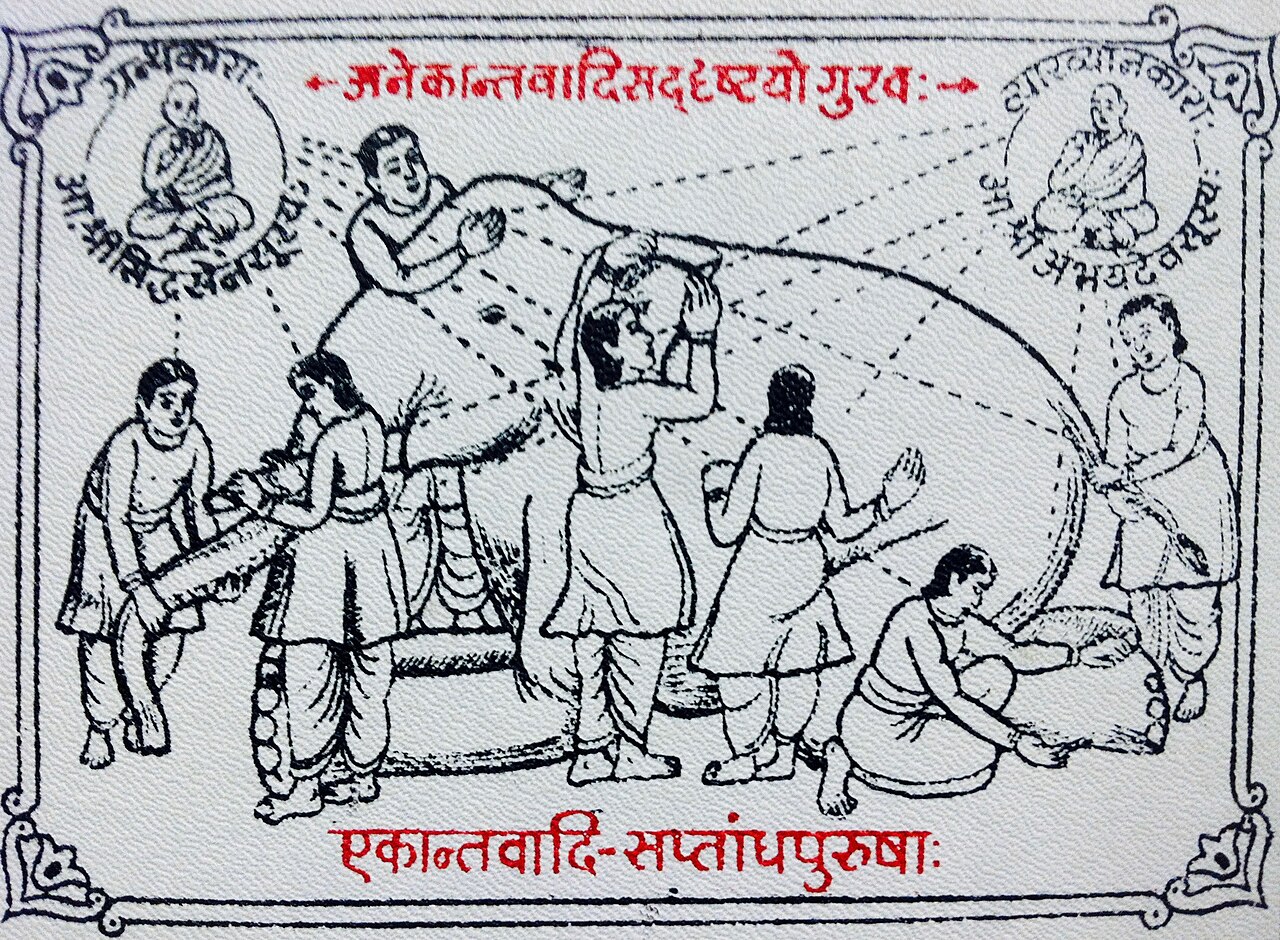
The Jain teaching that reality has many sides, how syadvada's sevenfold predication and the theory of standpoints work, where the elephant parable comes from, and why it matters now.
A king gathers men blind from birth and has each touch a different part of an elephant. The one holding the ear announces the elephant is a winnowing fan; the leg, a pillar; the trunk, a plough-pole; the tusk, a ploughshare; the tail, a brush. Each is partly right, wholly convinced, and soon they are shouting, in some versions, brawling.
The story is older than any single tradition’s use of it. One of its earliest recorded versions appears in the Buddhist Udana (6.4), where the Buddha tells it to describe quarreling sectarian teachers. But it was Jain philosophy that built the parable into a formal epistemology. Two celebrated Jain uses come from Vidyanandi’s Tattvarthaslokavartika in the ninth century and from Mallisena’s Syadvadamanjari in the thirteenth, where it appears twice. For Mallisena, whenever a person absolutizes one true aspect of a thing and denies the rest, “this is the maxim of the blind men and the elephant.” The doctrine behind that diagnosis is anekantavada, literally, the teaching (vada) of non-one-sidedness (anekanta): reality is many-sided, and no single proposition captures it whole.
The metaphysical root
Anekantavada is not, at bottom, a theory about tolerance; it is a theory about what things are. Jain metaphysics holds that every existent is simultaneously enduring substance (dravya) and changing modes (paryaya). The Tattvartha Sutra compresses this into a definition of existence itself: whatever exists is “furnished with origination, cessation, and persistence” (utpada-vyaya-dhrauvya-yuktam sat, Tattvartha Sutra 5.29; numbered 5.30 in Digambara recensions). A clay pot comes into being, will perish, and is throughout these changes clay. Is it permanent or impermanent? The Jain answer: genuinely both, in different respects.
Canonical dialogues attribute this style of answering to Mahavira himself. Asked whether the soul is eternal, he replies that it is eternal as substance and non-eternal in its changing states. Where the Buddha famously set aside certain metaphysical questions as unanswerable, Mahavira’s tradition answered them, from multiple, explicitly flagged standpoints. Later thinkers such as Siddhasena Divakara and Samantabhadra systematized this into full-fledged doctrine.
Syadvada: seven ways of saying
If reality is many-sided, honest speech about it needs machinery. That machinery is syadvada, the method of conditioned assertion. Each claim is prefixed with the Sanskrit particle syat, not “maybe,” as it is often mistranslated, but “in some respect” or “from a certain standpoint.” Applied systematically, it yields the saptabhangi, the sevenfold predication. Of any object and any property, one may say:
- In some respect, it is (syad asti).
- In some respect, it is not (syan nasti).
- In some respect, it is and it is not (taking the standpoints in succession).
- In some respect, it is inexpressible (syad avaktavyam, when both standpoints are demanded at once, language fails).
- In some respect, it is, and is inexpressible.
- In some respect, it is not, and is inexpressible.
- In some respect, it is, is not, and is inexpressible.
A pot is, as this clay object here and now; it is not as gold, as elsewhere, as tomorrow’s shards. Neither claim is hedged; each is true, precisely because each is indexed to a standpoint. Modern logicians have taken an interest in the saptabhangi as an early, disciplined multi-valued logic, a system that expands the classical true/false pair without collapsing into contradiction.
Nayavada: the theory of standpoints
The third limb, nayavada, catalogues the standpoints themselves. The classical list names seven nayas, running from the most generic to the most particular: the common view (naigama), the collective view (sangraha), the practical view (vyavahara), the momentary view (rjusutra, attending only to the present state), and three increasingly fine-grained linguistic views (sabda, samabhirudha, evambhuta) that distinguish meanings by grammar, etymology, and current function. A naya is valid as far as it goes; it becomes a durnaya, a defective view, the moment it denies the standpoints it excludes. The blind men’s error, on this analysis, was never their data, it was the word “only.”
Not relativism
It is tempting to read all this as an ancient “everyone is right.” Jain philosophers explicitly rejected that reading. Mallisena insists the doctrine is no license for skepticism: assertions are conditionally true, but conditions can be stated and met, and a view that “admits no exception” is simply false. Anekantavada itself is asserted as true, a feature rival philosophers, including Advaita Vedanta’s Shankara, seized upon in their critiques, and which Jain logicians answered at length. The doctrine ranks claims; it does not flatten them. Whole positions can still be wrong , chiefly by absolutizing.
Nor is it detached from ethics. Jain writers link anekantavada to ahimsa as its intellectual expression: dogmatic one-sidedness is a subtle violence toward both truth and opponents, and the discipline of asking “in what respect is my opponent right?” is non-harm practiced in argument.
Many-sidedness in a polarized age
The doctrine’s modern career has been vigorous. Gandhi credited the Jain doctrine of the many-sidedness of reality with teaching him to seek the partial truth in his opponents’ positions, a habit visible in his negotiating style. Contemporary scholars such as Jeffery Long have proposed anekantavada as a resource for interreligious understanding that avoids both exclusivism and mushy relativism.
Its everyday application is more modest and more demanding. Online discourse runs almost entirely on unindexed assertions: X is good, Y is a disaster, with the standpoint concealed or unexamined. The syadvada habit, silently restoring the missing “in some respect, from this standpoint, given this evidence” , is a portable discipline any reader can adopt. It changes what you share, how you disagree, and how quickly you reach for “only.” It pairs naturally with the interpretive humility we recommend in how to read scripture: texts, like elephants, reward investigators who assume there is more animal than the part in their hands.
Jainism’s own internal history offers a quiet test case: the Digambara and Svetambara traditions have disagreed for two millennia about monastic dress, scripture, and gender, while both revere the doctrine that insists the other side may be holding a genuine part of the elephant. Many-sidedness has not dissolved their differences. It has, at its best, kept the argument from becoming the brawl at the end of the parable , which may be exactly what a doctrine of intellectual non-violence is for.