
Jainism
Ahimsa in Jain Thought: Carefulness as Spiritual Strength
How Jain teaching turns non-harm into a whole way of life, from the classical definition of violence in the Tattvartha Sutra to diet, livelihood, and the season of forgiveness.
Ahimsa at the center
Jain tradition is renowned for placing ahimsa at the heart of spiritual life. The commitment shapes diet, movement, speech, and work. Far from passivity, this carefulness is framed as strength: the courage to restrain impulses that injure. The Acaranga Sutra, among the oldest surviving Jain scriptures, whose earliest portions scholars date to roughly the fourth or third century BCE, states the principle without qualification: “All breathing, existing, living, sentient creatures should not be slain, nor treated with violence, nor abused, nor tormented, nor driven away” (Acaranga Sutra 1.4.1, in Hermann Jacobi’s 1884 translation). The text calls this “the pure, unchangeable, eternal law.” For a broader comparison of how non-harm functions across traditions, see our overview of ahimsa as a shared ideal.
What the tradition means by harm
Jain thinkers did not leave “harm” vague. The Tattvartha Sutra, the compact Sanskrit summary of doctrine accepted by all Jain communities, defines it precisely: pramattayogat prana-vyaparopanam himsa. “the severance of vitalities out of passion” or careless activity (Tattvartha Sutra 7.13). Two things stand out in that definition. First, harm is measured against pranas, the vitalities or life-functions of a being, not merely against death. Second, the qualifying word pramatta careless, intoxicated by passion, makes the inner state decisive. A surgeon and an assailant may both cut flesh; Jain ethics distinguishes them by intention and by the presence or absence of vigilance.
This is why Jain teachers speak less about avoiding a list of forbidden acts and more about cultivating apramada, sustained carefulness. Violence committed knowingly and with relish binds heavy karma; injury that occurs despite genuine caution binds far less. The tradition’s moral psychology runs on attention.
A world dense with life
The seriousness of Jain carefulness follows from Jain biology. Classical texts classify living beings by the number of senses they possess: one-sensed beings (ekendriya) include earth-bodied, water-bodied, fire-bodied, and air-bodied organisms as well as plants; worms have two senses; ants three; flies four; and animals, humans, gods, and hell-beings have five. The second chapter of the Tattvartha Sutra maps this hierarchy in detail. Some texts also describe nigodas, microscopic clusters of one-sensed life pervading the cosmos.
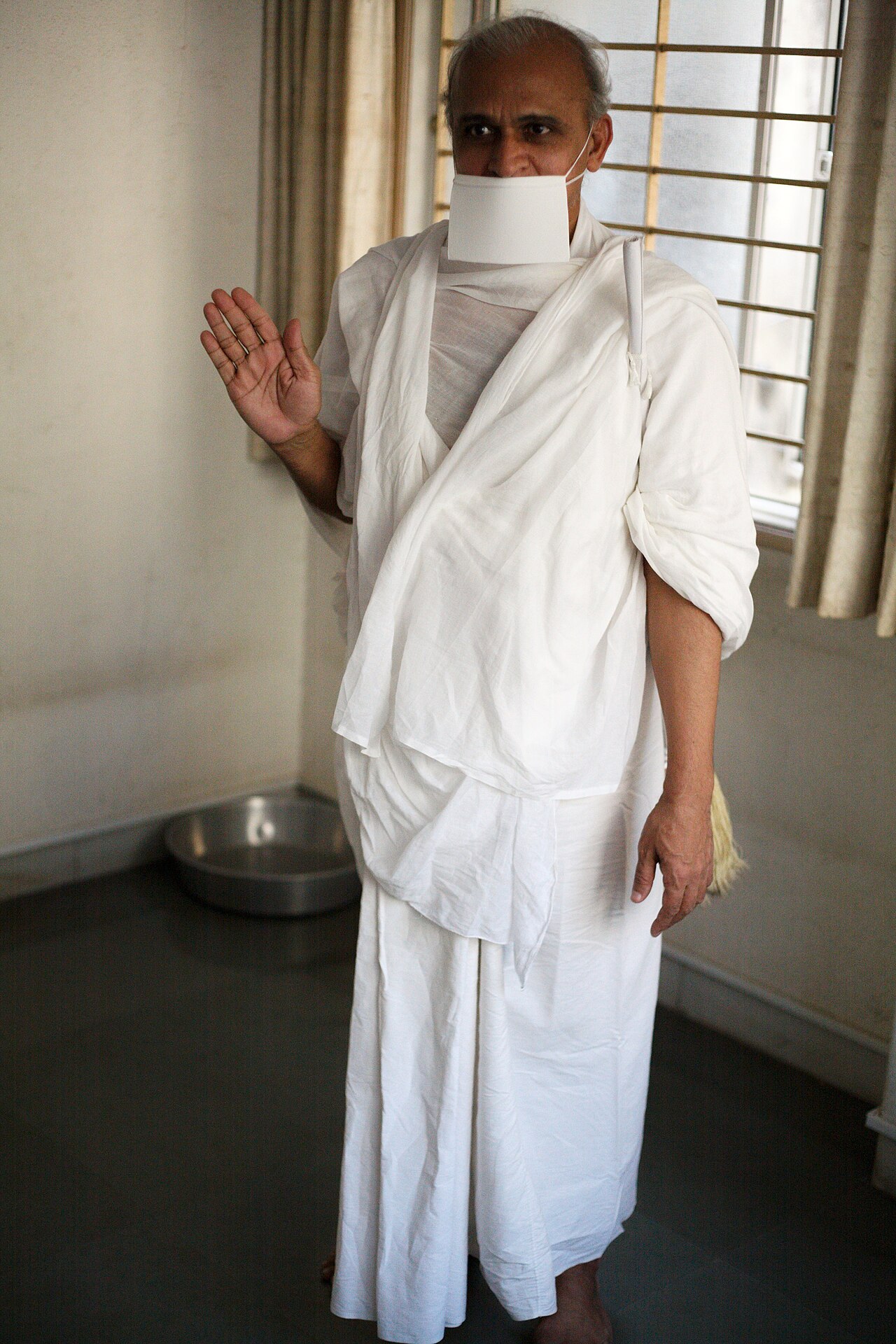
If life saturates soil, water, and air, then almost any action touches living beings. Jain ethics does not conclude that harm is therefore excusable; it concludes that harm must be minimized deliberately, and that harm to beings with more senses, who can suffer more, is graver than harm to beings with fewer. The hierarchy explains why strict Jains avoid root vegetables (harvesting kills the whole plant and the many organisms clustered around it), why observant households filter water, and why monastics sweep the ground before them as they walk.
Householders and renunciants
Renunciants undertake the strict mahavratas, the great vows; householders practice scaled disciplines called anuvratas, or lesser vows. Both orbits revolve around minimizing harm. Understanding this two-level structure prevents outsiders from misreading all Jains through monastic extremes, or ignoring the seriousness of lay vows. The Tattvartha Sutra states the difference in a single compressed line: the vow is “minor” or “great” according to whether abstention is partial or complete (Tattvartha Sutra 7.2). We examine that architecture fully in our guide to the five great vows of Jainism.
For monks and nuns, ahimsa is elaborated through the five samitis, or carefulnesses: care in walking, care in speaking, care in accepting food, care in picking up and setting down objects, and care in disposing of waste. Each samiti converts an ordinary bodily function into a site of ethical attention. A layperson cannot keep all of them in monastic form, but the pattern, treat routine actions as morally live, travels well into any household.
Practical expressions
Many Jain communities emphasize vegetarian or stricter diets, filtered water in some contexts, honesty in business, and restraint in speech. Details vary by sect and region: some families avoid eating after dark, since cooking by lamplight attracts and kills insects; some observe periodic fasts; some avoid fermented foods. The shared aim is vigilance: life is pervasive, so care must be pervasive.
Livelihood is part of the same calculus. Historically, many Jain families concentrated in trade, finance, and commerce partly because agriculture unavoidably injures soil organisms, and professions like butchery or brewing are ruled out entirely. Classical lay guides list trades a serious householder should avoid, those involving fire, clearing forests, selling weapons, or trafficking in animals. The prosperity of Jain merchant communities across western India grew, in part, from an ethical filter applied to work itself.
Care extends outward institutionally. Jain communities have long endowed panjrapoles, shelters for old, sick, or abandoned animals, and continue to fund animal-welfare and vegetarian-advocacy causes today. Ahimsa in Jain practice is not only refraining; it is building.
Seasonal deepening
Festivals such as Paryushana intensify reflection, forgiveness, and study. Ahimsa then becomes interpersonal: seeking and offering forgiveness for harms done knowingly or unknowingly. The festival’s closing words. micchami dukkadam, “may my wrong actions be without consequence”, treat even social friction as a species of injury requiring repair. It is a yearly reminder that the tradition counts words and neglect among the instruments of harm, alongside knives and fists.
A quiet influence beyond the tradition
Jain ahimsa has shaped people who never became Jains. Mohandas Gandhi, raised in Gujarat amid strong Jain influence, corresponded for years with the Jain lay philosopher Shrimad Rajchandra and named him, alongside Tolstoy and Ruskin, as one of the three modern figures who most shaped his thinking. Gandhi’s insistence that non-violence is the weapon of the strong, not the refuge of the timid, echoes the Jain framing of ahimsa as conquest of one’s own passions: the very word Jina, from which “Jain” derives, means “conqueror.”
Even without adopting Jain metaphysics, one can learn from the tradition’s refusal to treat small harms as ethically invisible. A tradition that asks whether one’s walking, speaking, and shopping injure anyone is a tradition that has made attention itself a moral act. Most of us will not filter our water or sweep our path. But the underlying discipline, noticing whom our routines touch, and refusing to call the damage negligible just because it is habitual, is available to anyone.