
Festivals
Holi: Color, Story, and the Work of Renewal
The Prahlad and Holika story from the Puranas, Krishna's Holi in Braj, the two days of the festival, and how to celebrate with natural colors and real consent.
Many Holis
Holi is famous for colored powder and water, yet its meanings vary. Some communities highlight the story of Prahlad and Holika, devotion surviving persecution, and the burning of winter’s leftovers in bonfires. Others emphasize spring’s agricultural turn and Krishna’s playful legends in the Braj region around Mathura. Falling on the full moon of Phalguna (February–March), Holi sits at the hinge between winter and the new agricultural year, which is why fire, color, and social thaw all belong to it.
The story behind the bonfire
The tale most often told at Holi comes from the Puranas, the Vishnu Purana and, in its fullest form, the seventh canto of the Bhagavata Purana. The demon-king Hiranyakashipu won a boon that made him nearly unkillable: he could not die by day or night, indoors or outdoors, on the ground or in the sky, at the hand of man or beast. Power without limit curdled into tyranny, and he demanded to be worshipped as god. His own young son, Prahlad, refused, remaining serenely devoted to Vishnu through every punishment his father devised.
Enter Holika, the king’s sister, who possessed a garment (in some tellings, an innate power) that made her immune to fire. She sat in a blazing pyre with Prahlad on her lap, expecting to walk out alone. The protection failed, turned to murder, the boon deserted her, and Holika burned while the boy emerged unharmed. The story ends beyond the fire: Vishnu appeared as Narasimha, the man-lion who was neither man nor beast, at twilight that was neither day nor night, on a threshold neither indoors nor out, and ended the tyrant on his own lap, satisfying every clause of the boon. The bonfire lit on Holi’s eve, Holika Dahan, replays the moment the fire chose the child over the arsonist.
Two days, two moods
Holi is properly a two-day festival. On the evening of the full moon, communities build and light the Holika Dahan bonfire, old wood, last season’s debris, sometimes stalks of the new grain harvest roasted in the flames and shared. The mood is solemn-festive: a purification, a burning of the year’s accumulated bitterness. In parts of North India the eight days before the fire, called Holashtaka, are traditionally kept free of weddings and new ventures, a quiet build-up to the blaze.
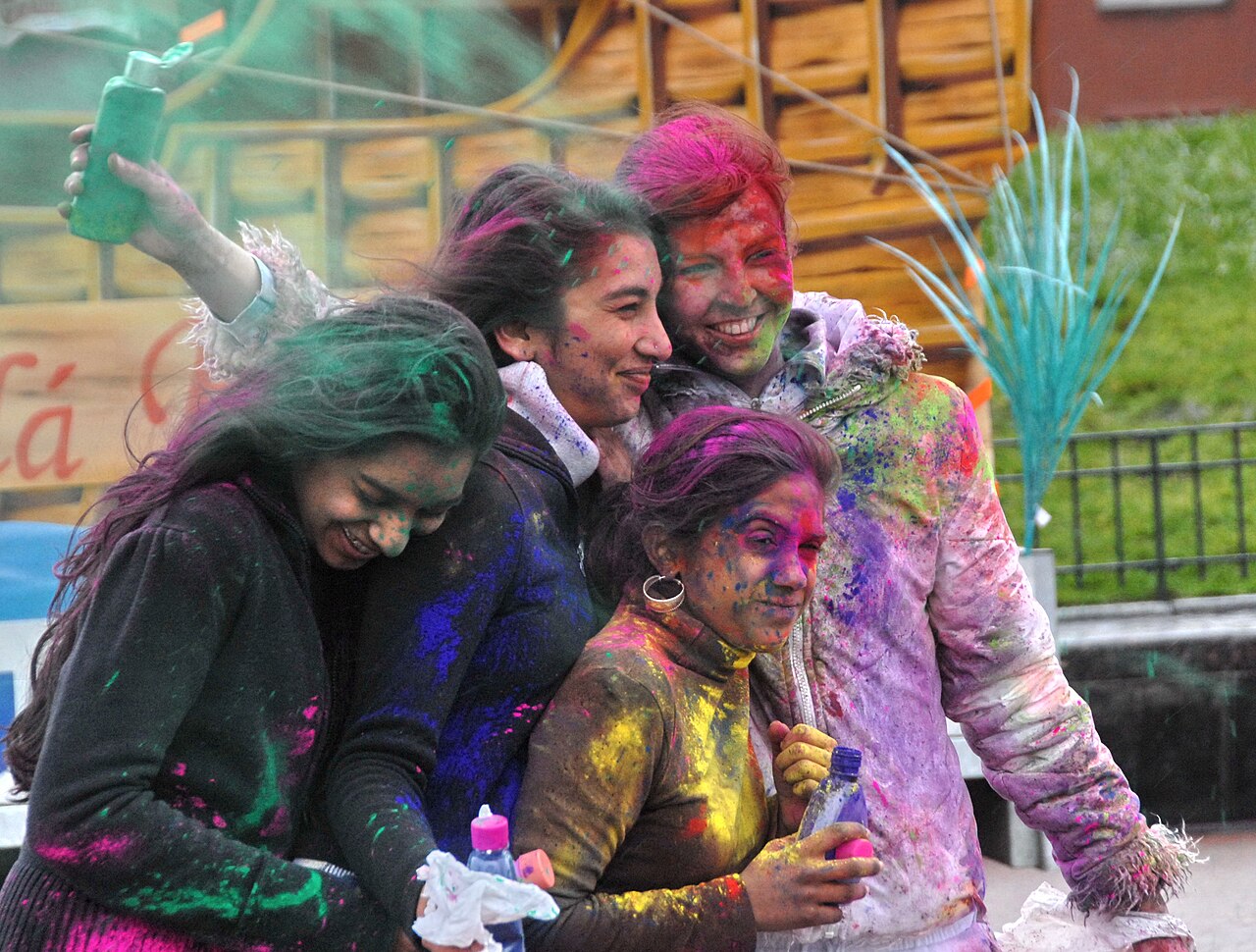
The next morning everything inverts. Rangwali Holi (also called Dhulandi) is the day of color: gulal powder, water, music, and the temporary suspension of the social distances that govern the rest of the year. Elders and children, neighbors and strangers, all end the morning the same shade of pink. The customary greeting. bura na mano, Holi hai, “don’t take offense, it’s Holi”, captures the day’s license and, as we discuss below, its limits.
Krishna’s Holi in Braj
In the Braj region of Uttar Pradesh: Mathura, Vrindavan, Barsana, Nandgaon, the landscape of Krishna’s childhood, Holi is less a day than a season, and its patron is not Prahlad but Krishna. A beloved folk telling has the dark-skinned young Krishna complaining to his mother Yashoda that Radha is fair while he is not; Yashoda laughingly suggests he color Radha’s face whatever shade he likes. The smearing of gulal between lovers and friends descends from that mischief, and Braj devotional traditions treat the color-play as an enactment of Radha and Krishna’s lila, divine play. (For newcomers to Krishna’s larger story, our beginner’s guide to the Bhagavad Gita introduces the same figure in a very different register.)
Braj celebrates for more than a week. The most famous event is Lathmar Holi: in Barsana, Radha’s home village, women meet the men who arrive from Krishna’s Nandgaon with long staves (lathis), driving them back in ritualized combat while the men defend themselves with shields, a re-enactment of Barsana’s women chasing off the teasing Krishna and his friends. Nandgaon returns the hospitality the following day. Temples in Vrindavan hold Phoolon wali Holi, played with flower petals, and in recent years the widows of Vrindavan, long excluded from festivity by custom, have publicly joined the color-play, a small, deliberate act of social repair.
Choosing your colors
Traditional Holi colors were botanical: the flame-orange flowers of the tesu or palash tree soaked overnight for saffron water, turmeric for yellow, henna for green, beetroot for magenta. They cooled the skin at the turn of the season and washed out of rivers harmlessly. Many modern market powders are another matter, industrial dyes, mica, glass powder, and heavy metals have all been documented in cheap gulal, and ophthalmology researchers have catalogued serious eye injuries from the festival. The fix is simple and increasingly easy: buy certified natural or herbal colors, or make them at home from kitchen staples. Choosing them is not fussiness; it is ahimsa applied to your neighbor’s skin, eyes, and drinking water.
Joy with boundaries
Celebrating well means consent: not everyone wants color on their clothes or face. “Bura na mano, Holi hai” was never meant to license grabbing, dousing strangers, or targeting women, and in recent years communities and campuses across India and the diaspora have pushed back on exactly that misuse. A few workable norms: ask before applying color to anyone you don’t know well; dry gulal on the face is not permission for water or worse; respect a “no” instantly; go easy on bhang and alcohol, which are traditional in some regions but corrode judgment; and keep color away from eyes, mouths, street animals, and people who have opted out. Festive freedom that ignores others’ dignity stops being festive.
Ethical reading of the stories
Narratives of arrogance destroyed and devotion protected invite self-examination: where do we rely on power without conscience? Hiranyakashipu’s boon is a portrait of the fantasy that enough leverage makes one untouchable; Holika’s end is a warning about lending one’s gifts to someone else’s cruelty. Holi can be laughter and moral memory, the fire and the color belong to the same lesson.
Community practice
Share sweets: gujiya in the north, puran poli in Maharashtra, visit friends, and repair small coldnesses that winter routines created. The old custom holds that on Holi even enemies embrace and begin again. Renewal is social as much as seasonal, and a festival that ends with everyone the same color makes the point better than a sermon could.