
Festivals
Navaratri: Nine Nights of Devotion and Discipline
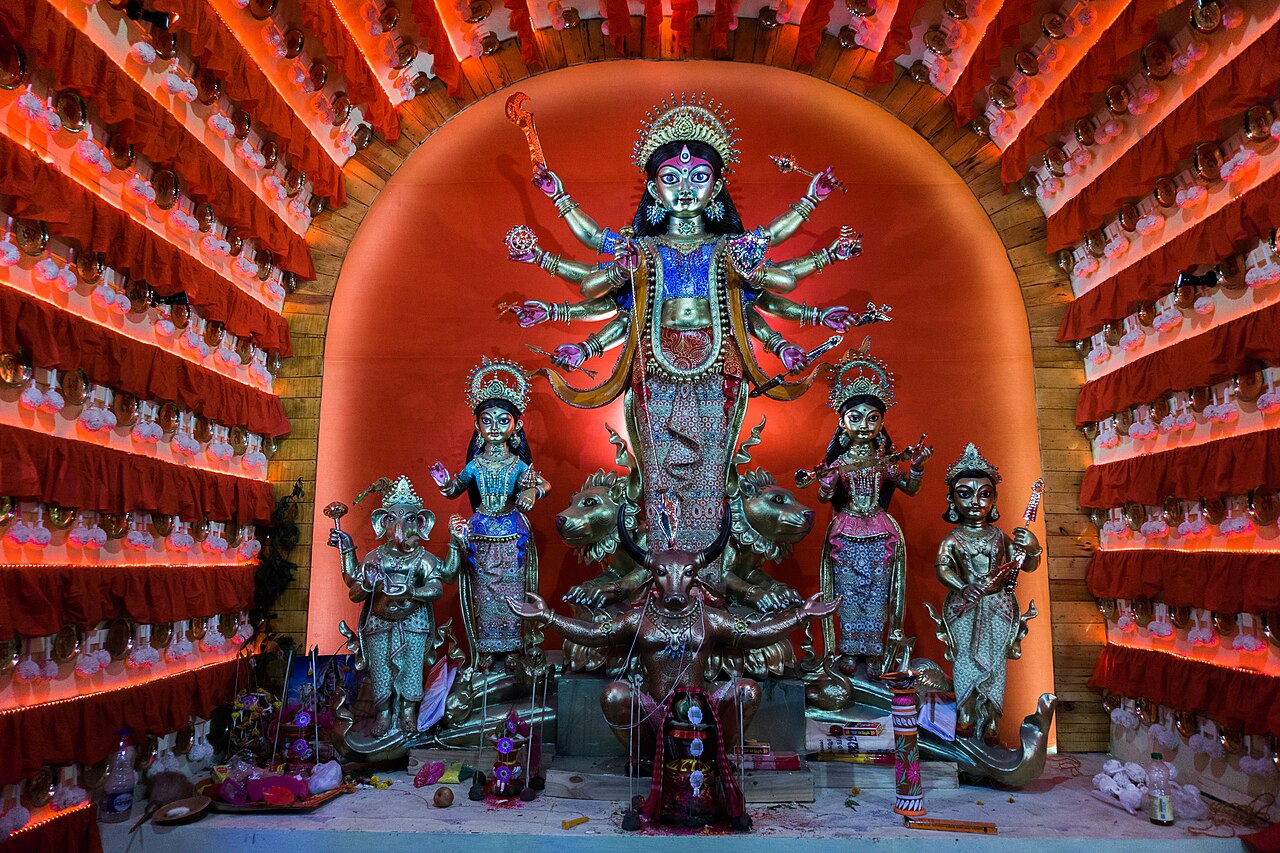
The nine forms of the Goddess night by night, the Devi Mahatmya story behind the festival, and how Gujarat, Bengal, and South India each make Navaratri their own.
What the nights mark
Navaratri (“nine nights”) honors the Divine Mother in forms associated with strength, wisdom, and compassionate power. Across India, the nine nights take strikingly different public shapes: whirling Garba circles in Gujarat, monumental Durga Puja pandals in Bengal, tiered doll displays in Tamil homes, and varied temple observances elsewhere. Several Navaratris dot the Hindu calendar, but the great autumn one. Sharad Navaratri, in the month of Ashvina (September–October), is the festival most people mean by the name.
The battle at the festival’s heart
The story underneath the nine nights comes from the Devi Mahatmya, a Sanskrit text of roughly the fifth to sixth century embedded in the Markandeya Purana and recited throughout the festival. The buffalo demon Mahishasura, unbeatable by god or man, had driven the gods from heaven. Their combined radiance took form as Durga, a goddess bearing a weapon from each god, riding a lion, and for nine nights she fought the shape-shifting demon, destroying him on the tenth day. That tenth day is Vijayadashami, “the victory tenth.” The tradition is careful about what this violence means: the Goddess destroys what refuses every other correction, and her battle is read as the struggle against arrogance, cruelty, and ignorance in the self and in society, not a warrant for personal aggression.
Nine nights, nine forms
Many communities dedicate each night to one of the Navadurga, nine aspects of the Goddess that trace an arc from mountain daughter to bestower of liberation:
- Shailaputri, daughter of the Himalaya, the Goddess rooted in the natural world
- Brahmacharini, the ascetic, embodying tapas and resolve
- Chandraghanta, bearing a crescent-moon bell, courage that keeps its calm
- Kushmanda, the smiling creatrix whose warmth is said to seed the cosmos
- Skandamata, mother of the war-god Skanda, ferocity in service of protection
- Katyayani, the warrior form born to end Mahishasura
- Kalaratri, the dark, terrifying night that destroys fear itself
- Mahagauri, radiant purity after the battle’s grime
- Siddhidhatri, giver of attainments, the arc’s contemplative close
Read in sequence, the list is a curriculum: groundedness, discipline, courage, creativity, protectiveness, struggle, confrontation with fear, purification, and finally wisdom. Many households also perform kanya puja toward the festival’s end, honoring young girls as living images of the Goddess.
One festival, many regions
Gujarat dances. Garba, the name relates to garbha, “womb”, is danced in counter-clockwise circles around a clay pot holding a lamp, the flame standing for life carried within. Dandiya Raas follows, partners striking small sticks in rhythm as the tempo climbs. UNESCO inscribed Garba on its Intangible Cultural Heritage list in 2023, citing among other things how the dance floor dilutes lines of class and community. Nine nights of it is both devotion and serious cardio; the pious fast by day and dance by night.
Bengal builds. The last five nights of Navaratri are Durga Puja, when Kolkata becomes an open-air gallery of pandals, temporary pavilions housing sculpted clay images of Durga slaying Mahishasura, flanked by Lakshmi, Saraswati, Ganesha, and Kartikeya. The festival begins with Mahalaya’s pre-dawn recitations welcoming the Goddess home for her annual visit, and ends with married women smearing each other with vermilion (sindoor khela) before the images are processed to the river and immersed, a farewell to a daughter returning to her husband’s home. UNESCO inscribed Durga Puja in Kolkata in 2021, noting its blend of worship, public art, and civic festivity.
South India arranges. Tamil, Telugu, and Kannada households build a golu (or bommai golu): dolls and figurines on stepped platforms of an odd number of tiers, depicting deities, saints, epics, and cheerful scenes of ordinary life. Evenings fill with visiting, neighbors admire each other’s golu, sing devotional songs, and exchange gifts. The season’s ninth day brings Saraswati Puja and Ayudha Puja, when books, musical instruments, and tools of every trade, from a farmer’s plough to a programmer’s laptop, are cleaned, decorated, and honored, an acknowledgment that skill and livelihood are also sacred. In Kerala, Vijayadashami is Vidyarambham, when small children trace their first letters in rice, formally beginning their education. Mysuru’s royal Dasara procession, with the goddess Chamundeshwari carried on a caparisoned elephant, gives the season its most regal face.
North India stages. Across the Hindi belt the nine nights host Ramlila, serial theatrical tellings of the Ramayana, and Vijayadashami becomes Dussehra: towering effigies of Ravana, Kumbhakarna, and Meghnad go up in flames to mark Rama’s victory. That the same tenth day carries both Durga’s triumph and Rama’s is no contradiction, both stories say that dharma, long besieged, eventually prevails.
Fasting and feasting
Many observers fast for some or all of the nine days, though “fasting” spans a wide range: a single evening meal, fruit and milk only, or the North Indian phalahar pattern that avoids grains, onion, garlic, and regular salt in favor of buckwheat, water-chestnut flour, potatoes, and rock salt. The intent is sattvic simplicity, lightening the body’s demands so attention can turn elsewhere, not endurance sport. Households sensibly adapt for children, pregnancy, illness, and medication schedules; the tradition itself treats the fast as an offering, and an offering that damages health honors no one. The nightly music and dance are not a contradiction of the fast but its companion: Navaratri holds restraint and celebration in the same two hands.
Attending well
Public Navaratri events genuinely welcome newcomers, garba organizers will happily teach the basic step, and Durga Puja pandals expect crowds of every background. A few courtesies help: dress modestly at anything temple-adjacent, remove shoes where others do, ask before photographing worship (the images, the priests, and especially other worshippers), and accept prasad with the right hand. Our primer on temple etiquette covers the details. And a suggestion for the curious: read one regional tradition deeply rather than mixing every custom into a blur, nine nights in Kolkata and nine nights in Ahmedabad are different educations, and each rewards attention on its own terms.