
Festivals
Mahashivratri: The Great Night of Shiva
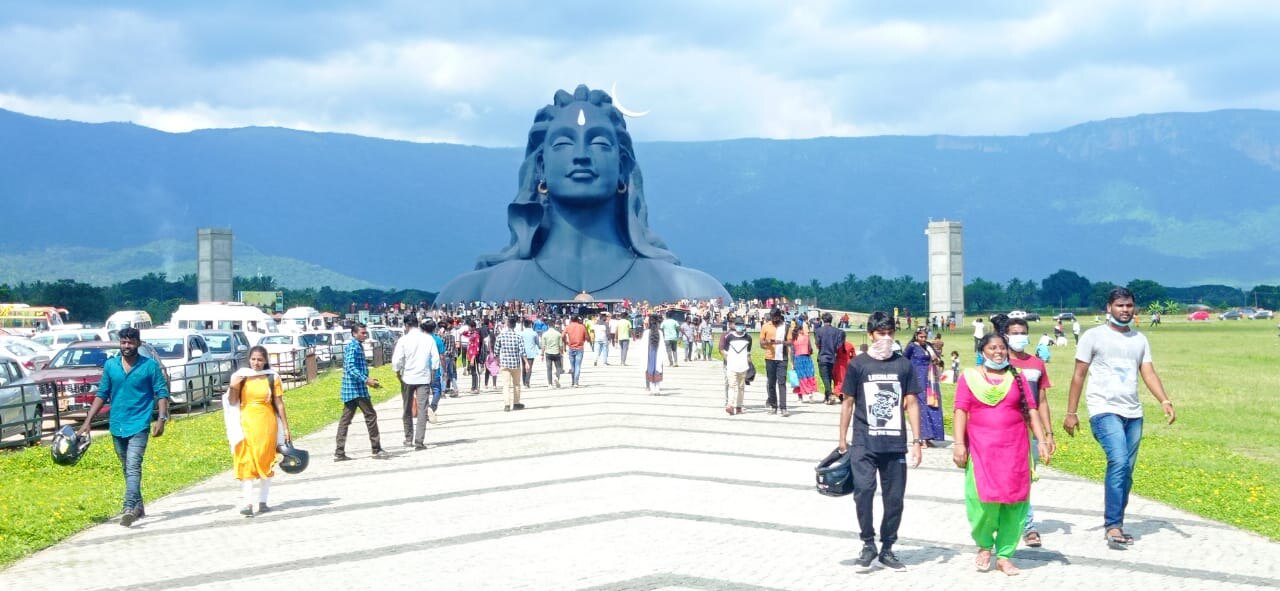
The Phalguna festival of Shiva's night vigil: marriage and poison stories, four-prahar worship, bilva and fasting, and the great Shiva shrines where crowds gather.
What the night marks
Mahashivratri, “the great night of Shiva,” falls in the lunar month of Phalguna (February–March), on the fourteenth day of the dark fortnight, Krishna Chaturdashi. Across India and the diaspora, devotees fast through the day, stay awake through the night, and pour into Shiva temples for abhisheka, the ritual bathing of the linga. The festival is not a single regional story told everywhere; it is a night of concentrated devotion to Shiva as ascetic, householder, destroyer of ignorance, and source of the teaching that became yoga.
Unlike many festivals built around a public procession or a harvest thanksgiving, Mahashivratri asks for interior discipline. The point is vigilance: to remain alert when the body wants sleep, to keep the mind turned toward the sacred when the world is quiet. That inward orientation links the festival to broader Hindu practice, where ritual is not decoration but training in attention and ethical seriousness.
Two founding stories
Hindu tradition preserves several explanations for why this night matters. Two dominate temple preaching and household memory.
The marriage story comes from the Shiva Purana and related texts. After the death of his first wife Sati, Shiva withdrew into austere meditation on Mount Kailash. The gods needed a force capable of confronting demons who had grown too strong for heaven alone. Only a son born of Shiva could lead the divine armies, but Shiva would not marry. The goddess Parvati, Sati reborn, undertook years of tapas, ascetic practice, to win him. On Phalguna Chaturdashi, their wedding was celebrated, and the night became auspicious for honoring Shiva as spouse and yogi alike. In many North Indian temples, the festival includes a symbolic wedding procession of Shiva and Parvati images.
The poison story belongs to the churning of the ocean (samudra manthan), one of the great cooperative myths of the Puranas. Gods and demons together churned the cosmic ocean to obtain the nectar of immortality. What surfaced first was a deadly poison, halahala, threatening to destroy creation. Shiva drank it to save the worlds, holding it in his throat, which turned blue. He is worshipped that night as Neelkanth, the blue-throated one. The story teaches that divine compassion absorbs what would otherwise annihilate, a theme that resonates with Shiva’s role as the deity who transforms what cannot be discarded.
Some communities also remember Lingodbhava, the appearance of the infinite pillar of light that Brahma and Vishnu could not measure, the origin story of the linga as Shiva’s sign. On Mahashivratri, the linga is not an abstract symbol alone; it is the focus of hours of continuous worship.
The four prahars of the night
Observant families structure the vigil around the four prahars, three-hour divisions of the night. Each prahar has its own round of puja: bathing the linga with water, milk, yogurt, honey, and ghee; offering bilva (Aegle marmelos) leaves, whose three leaflets are read as Shiva’s trident; ringing bells and chanting Om Namah Shivaya or regional hymns. Some temples perform Rudrabhisheka, recitation from the Shri Rudram of the Yajurveda while pouring offerings over the image.
Fasting varies. Many devotees take only fruit and milk through the day and break the fast after the final prahar or at sunrise. Others keep a strict fast with no food and sometimes no water until morning. The fast is understood less as penance for guilt and more as clearing the body for sustained attention, a physical parallel to the night’s spiritual aim.
Children often receive their first instruction in Shiva worship on this night. Grandparents tell the marriage and poison stories; teenagers who might skip an ordinary puja sometimes stay up because the social energy of a crowded temple makes devotion feel communal rather than imposed.
Bilva, bhang, and what is offered
The bilva leaf is the festival’s botanical signature. Scriptural praise links each leaflet to Shiva’s three eyes or to the three gunas, qualities of nature, offered back to their source. A single bilva leaf placed on the linga with devotion is said in popular teaching to outweigh richer offerings made without care. Markets near Shiva shrines sell bilva garlands by the thousands on Mahashivratri afternoon.
Offerings differ by region. In North India, bhang (a preparation from cannabis leaves) is consumed in some Shiva communities as prasad associated with the deity’s ascetic company, always within local legal and temple norms. In South India, the emphasis may fall on lamp arrays and continuous chanting in Tamil or Telugu. What remains constant is abhisheka: the act of bathing the deity, which dramatizes purification and the flow of grace from the invisible to the touchable.
Visitors unfamiliar with Shiva temples should read our guide to temple etiquette before going. Mahashivratri crowds are dense; modest dress, patience in queue, and willingness to follow volunteer directions matter more on this night than on an ordinary weekday visit.
Where the crowds go
Certain Shiva shrines become national magnets on Mahashivratri.
Kashi Vishwanath in Varanasi draws pilgrims who believe that to die in Kashi is to be released from the cycle of rebirth. On Mahashivratri, the lanes of the old city fill with processions, and the Ganga ghats host continuous aarti. Diana Eck’s study of Banaras describes how the city’s identity is inseparable from Shiva as Vishwanath, “Lord of the Universe.”
Ujjain, on the Shipra River in Madhya Pradesh, centers on the Mahakaleshwar Jyotirlinga, one of twelve especially sacred lingas named in scripture. The temple’s bhasma aarti, in which the linga is adorned with ash, is famous year-round and draws enormous numbers on this night.
Somnath in Gujarat, rebuilt across centuries and standing on the Arabian Sea, combines pilgrimage with the memory of regional history. Kedarnath and Amarnath in the Himalayas extend the festival into mountain terrain, where snow and altitude make the vigil a test of endurance. Pashupatinath on the Bagmati River in Kathmandu is the great Shiva shrine of the Himalayan valley, where sadhus gather in numbers visible from afar.
Not every observer travels. Home shrines matter equally. A linga or Shiva image on a shelf, a night of lamp light, and the names of Shiva repeated steadily until dawn fulfill the festival for countless families who cannot reach a major site.
What the vigil is for
Mahashivratri compresses several Hindu intuitions into one night: that the divine can be approached through austerity as well as through celebration; that destruction of poison, ego, and ignorance is an act of love; that marriage and meditation are not opposites in Shiva’s life. The festival does not promise material reward in the way Lakshmi puja at Diwali sometimes does. Its gift is simpler and harder: a night of practiced wakefulness.
Readers who want to situate Shiva within a wider frame of action and consequence can follow our overview of karma across traditions. Those drawn to the contemplative side of the night may find companionship in our piece on meditation across paths, where the shared logic of sustained attention appears in many forms.