
Hinduism
Yoga’s Philosophical Roots Beyond the Studio
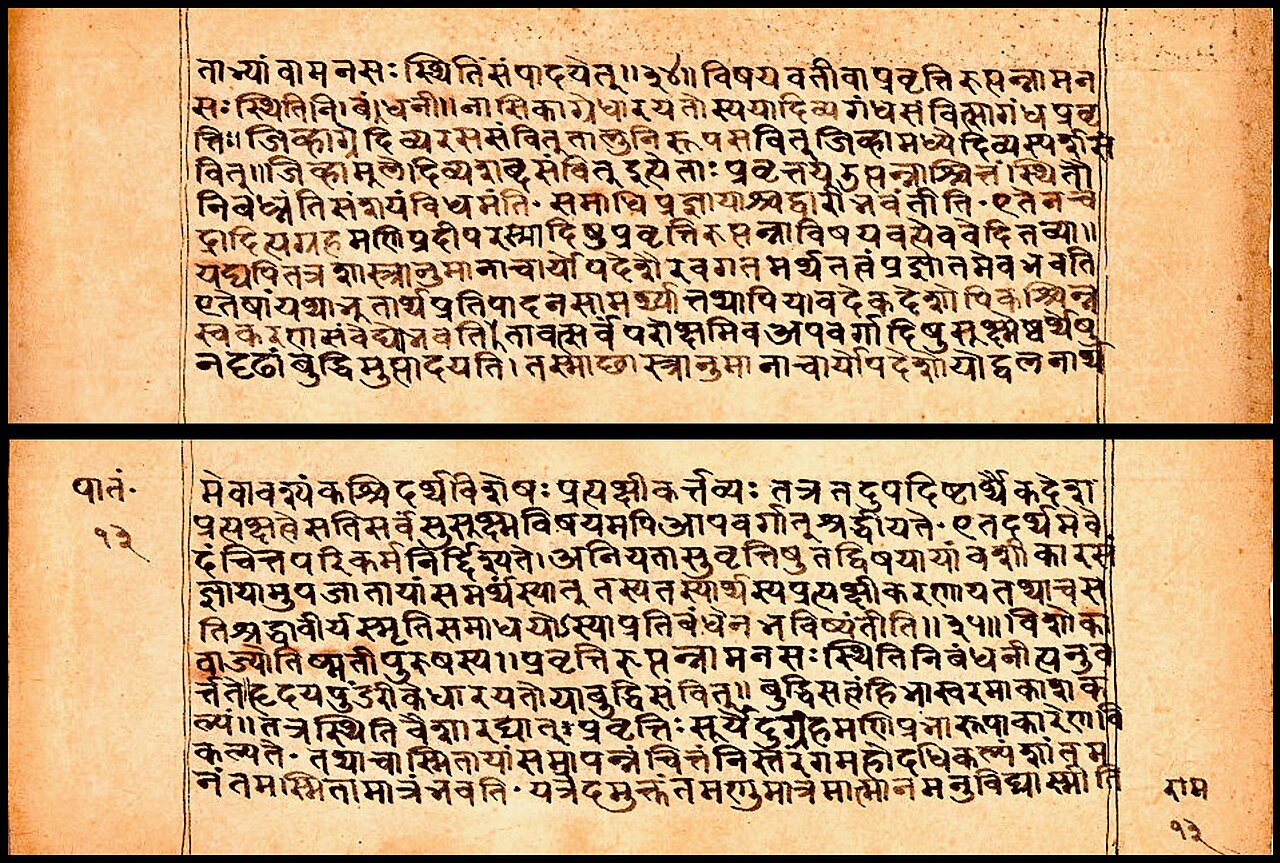
Asana is one limb of eight. How Patanjali's Yoga Sutras, the Upanishads, and the Bhagavad Gita frame yoga as a complete discipline of ethics, breath, and mind.
More than posture
Global yoga culture often begins with physical postures. Classical sources describe a wider discipline: ethical restraints (yama), observances (niyama), posture, breath regulation, sense withdrawal, concentration, meditation, and absorption. Posture supports the path; it does not exhaust it.
Patanjali’s map: the Yoga Sutras
The text that made this eightfold scheme famous is the Yoga Sutras of Patanjali, a compact collection of 195 or 196 aphorisms (manuscript traditions differ by one) compiled in the early centuries CE. It is organized into four chapters, or padas: on absorption (samadhi), on practice (sadhana), on extraordinary powers (vibhuti), and on liberation (kaivalya). Sutras are deliberately terse, memory hooks for oral teaching, so the text has always traveled with commentaries, the oldest and most authoritative being the one attributed to Vyasa.
The second sutra states the whole project: yogash chitta-vritti-nirodhah. “yoga is the stilling of the fluctuations of the mind” (Yoga Sutras 1.2). Everything else in the text is method for that stilling, and diagnosis of what prevents it. The famous eight limbs (ashtanga) are listed at sutra 2.29 and then explained one by one: yama, niyama, asana, pranayama, pratyahara, dharana, dhyana, samadhi. The first five are outer supports; the last three are the deepening interior states that Patanjali later treats as a single continuum.
Ethics as foundation
The limbs begin with conduct, not contortion. The five yamas, non-harm (ahimsa), truthfulness, non-stealing, restraint of appetite, and non-possessiveness, are called a “great vow” applying to everyone regardless of class, place, or circumstance (Yoga Sutras 2.31). The niyamas add cleanliness, contentment, discipline, self-study, and devotion.
These are not optional warm-ups. Without them, concentration techniques can sharpen ego rather than clarity. This is why serious teachers still talk about lifestyle, not only hamstrings.
Breath and mind
Breath practices link body and attention. The point in classical framing is not athletic breath-holding for its own sake, but steadying the mind’s weather: Patanjali introduces pranayama (2.49) only after posture is settled, and follows it with pratyahara, the withdrawal of the senses from their objects. Meditation then deepens that steadiness toward insight, a progression with close cousins in other contemplative traditions.
One limb among eight: asana in the classical text
Here is a fact that surprises many studio practitioners: in a text of nearly two hundred sutras, physical posture receives three. Patanjali defines asana in a single phrase. sthira-sukham asanam, “posture should be steady and comfortable” (Yoga Sutras 2.46), and says nothing about specific poses. The word asana derives from the root “to sit”; the classical concern is a seat stable enough for long meditation, not a sequence of shapes.
The flowing, gymnastic practice most of the world now calls yoga is largely a twentieth-century development. Scholars such as Mark Singleton have traced how teachers in early-1900s India, most influentially Tirumalai Krishnamacharya, working in Mysore, whose students B.K.S. Iyengar and K. Pattabhi Jois carried the work worldwide, synthesized older hatha yoga postures with modern physical culture into the dynamic asana systems taught today. Hatha yoga itself is a genuine medieval Indian tradition, attested in texts like the fifteenth-century Hatha Yoga Pradipika, which describes postures, breath work, and subtle-body practices. So modern postural yoga has real Indian roots, but it is one branch of a much larger tree, and the philosophical trunk is what this essay traces.
None of this makes posture practice illegitimate. It makes it partial. Knowing the difference protects students from marketing in both directions: from studios implying that a workout is the whole tradition, and from purists implying that the tradition never involved the body.
Older than Patanjali: yoga in the Upanishads and the Gita
Patanjali systematized; he did not invent. The word yoga, from a root meaning “to yoke,” appears with recognizably spiritual meaning in the Upanishads. The Katha Upanishad, likely composed centuries before the Yoga Sutras, declares: “When the five senses of knowledge stand still together with the mind, and the intellect does not stir, that they call the highest state. This firm holding of the senses is what is known as yoga” (Katha Upanishad 2.3.10–11). The Shvetashvatara Upanishad goes further, describing posture, breath control, and suitable places for practice.
The Bhagavad Gita uses the word constantly and flexibly. It offers one of the most quoted definitions in the tradition. samatvam yoga uchyate, “yoga is evenness of mind” (Gita 2.48), and another, “yoga is skill in action” (2.50). Its sixth chapter gives practical meditation instruction that any modern practitioner would recognize: a clean, steady seat, an upright spine, moderation in food and sleep, the mind repeatedly led back from wandering. The Gita’s larger contribution is to widen yoga beyond the meditator’s cushion into disciplines of action, knowledge, and devotion.
The samkhya connection
Classical yoga is philosophically paired with samkhya, one of the oldest systems of Hindu thought. Samkhya analyzes reality into two principles: purusha, pure consciousness, the witness; and prakriti, nature, everything that changes, including matter, energy, senses, and even mind and intellect. Suffering arises when consciousness misidentifies with nature’s movements, like a spectator forgetting the film is a film.
Patanjali adopts this framework almost wholesale. The “fluctuations of the mind” that yoga stills belong to prakriti; the stillness reveals purusha resting in its own nature (Yoga Sutras 1.3). Where Patanjali departs from classical samkhya is in adding Ishvara, a special, ever-free “lord”, and making devotion to Ishvara one valid path to absorption. Yoga is thus sometimes described as samkhya with a method, and with room for God.
Diversity of yoga
Bhakti, jnana, karma, and raja streams emphasize devotion, knowledge, action, and meditative discipline differently. Modern lineages adapt these streams for householders worldwide. Educational reading means noticing which stream a teacher represents rather than assuming one brand owns “real yoga.”
A balanced approach today
Physical practice can support health, and there is no shame in coming to yoga through the body, many great teachers did. Pairing practice with ethical reflection, some study of the source texts, and occasional silence restores contact with the philosophical roots. Read Patanjali in a good translation (Edwin Bryant’s edition includes the traditional commentaries; Barbara Stoler Miller’s is brief and elegant), sit quietly after the postures instead of rushing out, and let sthira-sukham steady and at ease, describe not just your seat but your relationship to the whole path.