
Buddhism
The Four Noble Truths: Buddhism’s Diagnostic Frame
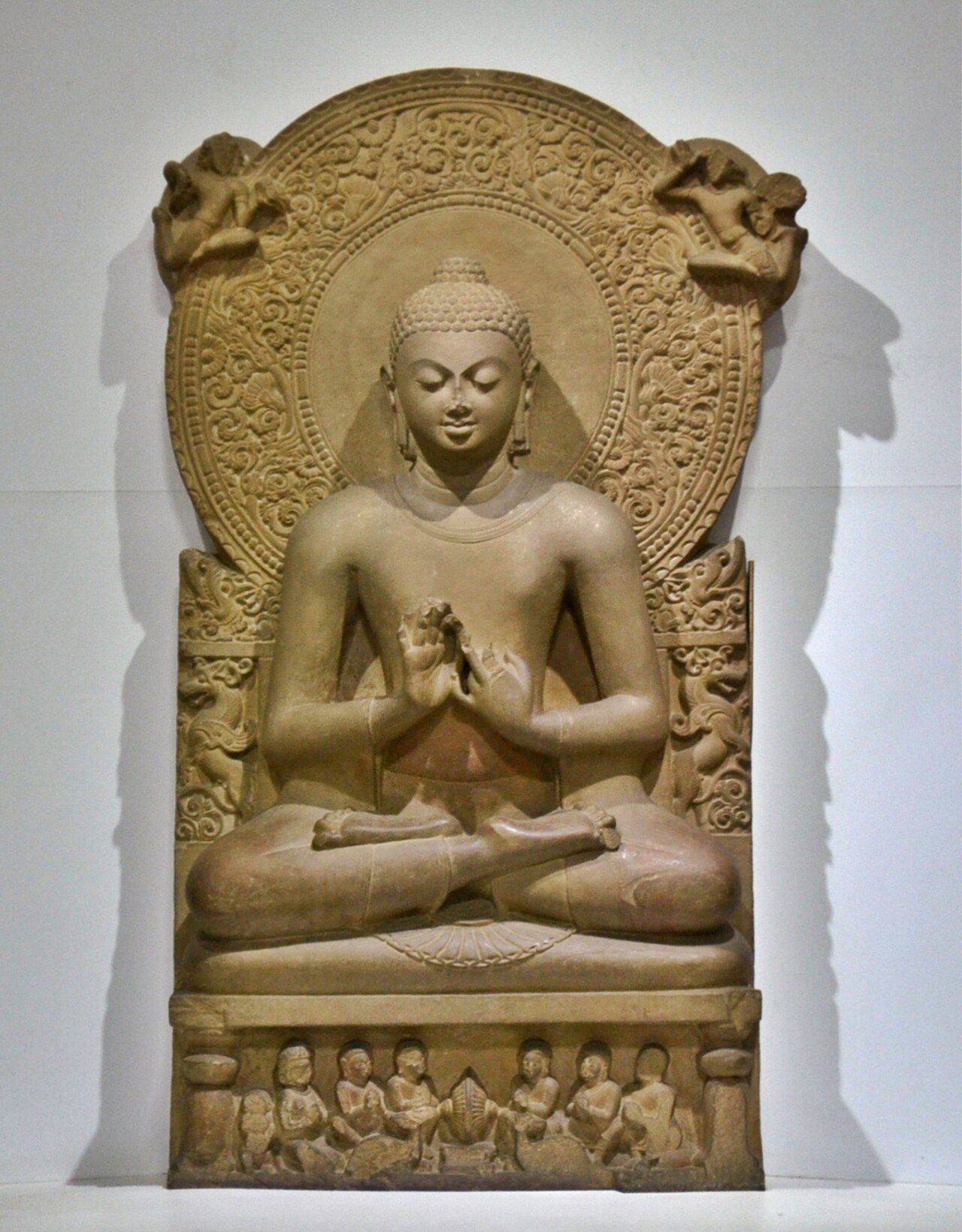
The Buddha’s first sermon at Sarnath framed distress and release as diagnosis and cure. A close look at dukkha, samudaya, nirodha, and magga, and the misreading that says Buddhism calls life 'suffering'.
A medical metaphor
Teachers often compare the Four Noble Truths to diagnosis and treatment: there is distress; it has causes; it can cease; there is a path. The comparison is old. In the Sela Sutta (Sutta Nipata 3.7) the Buddha calls himself bhisakko, a physician, and sallakatto anuttaro, an unsurpassed surgeon who draws out the arrow of craving. A discourse preserved in the Chinese Samyuktagama makes the parallel explicit: a good doctor knows the disease, its cause, its cure, and how to prevent relapse, and the Buddha knows suffering, its origin, its cessation, and the path. The metaphor helps, as long as we remember Buddhism is not only psychology, it is a full path of ethics, meditation, and wisdom.
The first sermon at Sarnath
Tradition places the first formal teaching of the four truths in the deer park at Isipatana, near Varanasi, the site known today as Sarnath. The discourse is the Dhammacakkappavattana Sutta, “Setting in Motion the Wheel of the Dhamma,” preserved in the Pali canon at Samyutta Nikaya 56.11. Its audience was small: the five ascetics who had practiced austerities alongside Gotama before he abandoned self-mortification for what the sutta calls the middle way between indulgence and self-torment.
The text ends with a detail worth pausing on. When the discourse concludes, only one listener, Kondañña, gains insight, expressed in the formula “whatever is subject to origination is all subject to cessation.” The Buddha’s response is simply, “Kondañña has understood.” Even in the tradition’s founding scene, the truths are not information to be received but something each hearer must see for themselves.
1. Dukkha, the truth of distress
Life includes birth, aging, illness, separation from what we love, and contact with what we resist. SN 56.11 summarizes: “in brief, the five aggregates subject to clinging are dukkha.” Dukkha is wider than “pain”; it names unsatisfactoriness woven through conditioned experience. Later texts and teachers distinguish three registers: dukkha-dukkhata, ordinary pain and grief; viparinama-dukkhata, the distress built into change, since even pleasant experience is unstable; and sankhara-dukkhata, the subtle inadequacy of all conditioned states. Walpola Rahula’s classic What the Buddha Taught devotes a chapter to untangling these layers for modern readers.
2. Samudaya, the origin
The second truth names the engine: tanha, craving, literally “thirst.” The sutta divides it three ways. kama-tanha, craving for sense pleasures; bhava-tanha, craving to be and become; and vibhava-tanha, craving for non-existence, the wish that experience would just stop. This is not a command to suppress all desire for food or friendship; it targets the thirst that demands the world obey the ego, in whichever of the three directions it runs.
3. Nirodha, cessation
If craving is relinquished, the distress it generates can cease. The sutta describes cessation as the “remainderless fading away” of that very craving, giving it up, letting it go, no longer leaning on it. Nibbana (Sanskrit: nirvana) language points to freedom, not annihilation of compassion. Traditions debate the metaphysics; practitioners test the claim in ethical and meditative life. The canon’s own emphasis is practical rather than speculative: in a famous passage in the Udana, the Buddha says that just as the great ocean has one taste, the taste of salt, “this Dhamma and discipline has one taste, the taste of freedom.” The third truth is that taste, promised as verifiable.
4. Magga, the path
The fourth truth is the treatment plan: the Noble Eightfold Path of view, intention, speech, action, livelihood, effort, mindfulness, and concentration. The truths are not merely believed; they are verified through practice, which is why the path itself is counted among the truths rather than appended afterward.
Four truths, four tasks
A structural feature of SN 56.11 is easy to miss in summaries: each truth comes with its own verb. Dukkha is to be fully understood (pariññeyya), its origin is to be abandoned (pahatabba), its cessation is to be realized (sacchikatabba), and the path is to be developed (bhavetabba). The Buddha describes his own awakening as knowing each truth in three phases, the truth itself, the task it demands, and the task completed, yielding what the text calls “three rounds and twelve aspects.” The four truths, in other words, are less a creed than a work order. You do not merely assent to the first truth; you study your own experience until you understand distress from the inside.
The center of the whole canon
The four truths are not one teaching among many; the early texts treat them as the organizing frame for everything else. In the Simsapa grove discourse (SN 56.31), the Buddha picks up a handful of leaves and tells the monks that what he has taught, compared with what he knows, is like the leaves in his hand against the leaves of the forest, and what he has taught is precisely the four truths, because only they conduce to liberation. Dependent origination unpacks the second truth; the teachings on impermanence and not-self serve the first; the entire training in ethics, meditation, and wisdom elaborates the fourth. Buddhaghosa’s fifth-century manual, the Visuddhimagga, devotes a full chapter to analyzing the truths, and every major Buddhist school, whatever else it added, kept them at the foundation.
Does Buddhism say life is suffering?
The most common misreading of the first truth flattens it into “Buddhism teaches that life is suffering”, a slogan that makes the tradition sound bleaker than its texts. The sutta does not say existence is nothing but misery; it enumerates specific occasions of dukkha and locates the deeper problem in clinging, not in life itself. Early Buddhist literature is full of accounts of joy: the pleasure of ethical blamelessness, the happiness of meditative absorption, the ease of relinquishment. The first truth is a diagnosis, and no honest physician tells a patient “you are your disease.” The claim is narrower and more testable: wherever there is clinging to what changes, friction follows, and that friction has a cause that can be worked with. Readers exploring how other Indian traditions handle related questions of bondage and release may find our overview of karma across traditions a useful companion.
Reading the sutta yourself
SN 56.11 is short, most translations run under two pages, and freely available. Bhikkhu Bodhi’s rendering appears in The Connected Discourses of the Buddha and on SuttaCentral; Thanissaro Bhikkhu’s is on Access to Insight. Reading the primary text after an explainer like this one is instructive, mostly for what is not there: no pessimism, no metaphysical system-building, just a diagnosis, a cause, a prognosis, and a prescription delivered to five skeptical friends in a deer park. Anyone who has watched a craving create unnecessary conflict can taste the diagnostic power for themselves, and the contemplative practices that grew from this framework are where the testing happens.