
Buddhism
Mindfulness and Ritual: Allies, Not Rivals
The Satipatthana Sutta, temple liturgy, and the modern secular-mindfulness debate, why Buddhist traditions across Asia hold meditation and ceremony together, and what gets lost when they are split apart.
A modern split
Some contemporary readers treat mindfulness as scientific and ritual as outdated. Traditional Buddhist cultures rarely make that sharp cut. Chanting, bowing, offering, and communal calendar life support the same training of attention and humility that silent sitting develops. Understanding why requires looking at what the tradition’s foundational meditation text actually says, and at how living Buddhist communities have always surrounded it.
What the Satipatthana Sutta teaches
The charter text for Buddhist mindfulness is the Satipatthana Sutta (Majjhima Nikaya 10, with an expanded parallel at Digha Nikaya 22). It opens by calling the four establishments of mindfulness the ekayano maggo, rendered by Ñanamoli and Bodhi as “the direct path”, to the purification of beings. The four establishments are contemplation of the body (breathing, postures, activities, anatomy, the elements, and the decay of corpses), of feeling-tones, of the mind’s states, and of dhammas, categories of experience including the hindrances, the aggregates, and the Four Noble Truths themselves.
Notice what this is not: a relaxation technique. The sutta’s refrain instructs the practitioner to contemplate arising and vanishing, impermanence, in every object, “ardent, clearly comprehending, mindful.” And the word sati itself carries freight that “mindfulness” hides. It derives from a root meaning to remember. Sati is not bare attention alone but attention that keeps something in mind: the teaching, the training, the reason one is practicing at all. That memory-dimension is exactly where ritual enters.
What ritual trains
Ritual embodies values: gratitude, refuge, continuity with teachers, and belonging. Repeating forms can steady a restless mind just as a melody steadies breath. When done mechanically, ritual empties; when done with attention, it becomes mindfulness in motion. A traditional flower offering, for instance, is often accompanied by a verse noting that the blossoms will wilt, the offering is a contemplation of impermanence, the same insight the Satipatthana refrain asks of a meditator on a cushion.
Historians of Buddhism add a corrective to modern assumptions here: for most of Buddhist history, in most places, sustained silent meditation was a specialist pursuit, cultivated intensively by a minority of monastics, while the broad religious life of lay communities ran on generosity, precepts, chanting, festivals, and merit-making. The widespread expectation that every lay Buddhist “should” meditate daily is largely a product of nineteenth- and twentieth-century reform movements and the modern vipassana revival. That history does not diminish meditation, it clarifies that ritual was never a degraded substitute for it, but the tradition’s primary vehicle for forming character at scale.
Three Buddhist worlds, one weave
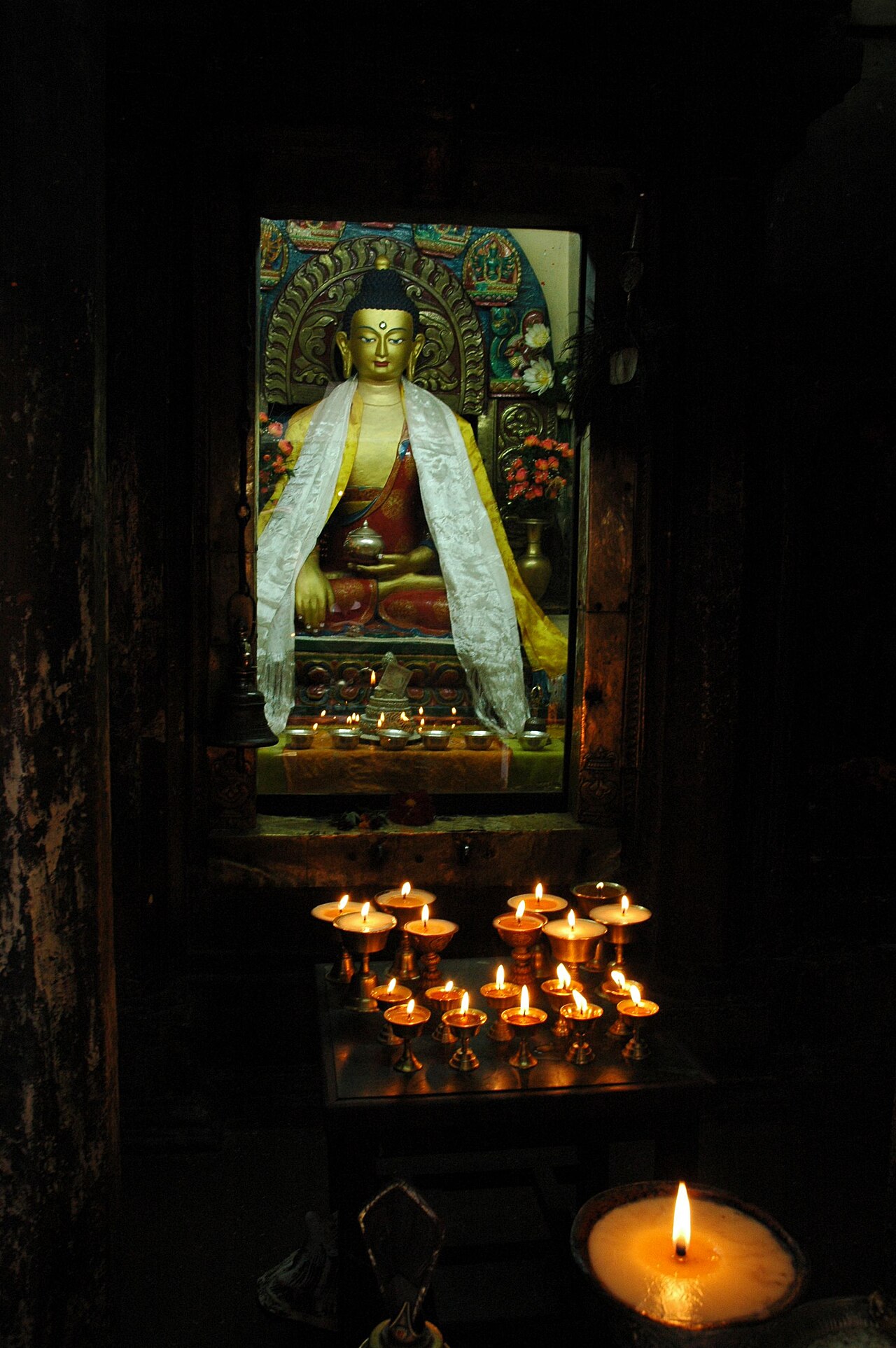
In Theravada communities, the day at a temple typically braids devotion and meditation without ceremony about the distinction: buddha-puja (offerings of flowers, incense, and light before an image), taking the refuges and precepts, paritta chanting for protection and blessing, then perhaps a period of sitting or walking meditation. The chants are largely canonical passages; chanting them is simultaneously liturgy and memorization of doctrine.
Mahayana traditions elaborate the liturgical side further. A Zen monastery, often stereotyped in the West as ritual-free minimalism, runs on ceremony: bowing on entering the hall, formal meal practice, sutra services morning and evening, with silent zazen embedded in that container rather than isolated from it. Pure Land practitioners recite the Buddha’s name as their central act, a practice that is at once devotional and a sustained training of attention.
Vajrayana makes the fusion most explicit. The preliminary practices (ngondro) of Tibetan traditions famously include one hundred thousand full prostrations, along with mantra recitation and elaborate visualization, physical, vocal, and mental acts choreographed together precisely so that body, speech, and mind cannot drift apart. Whatever one makes of the metaphysics, as attention training it is difficult to call this anything but mindfulness at high intensity.
The canonical caution, read carefully
Skeptics of ritual sometimes cite the early texts’ own warning: silabbata-paramasa, often translated “clinging to rites and rituals,” is one of the first three fetters abandoned at stream-entry. But the fetter is the clinging, the belief that ceremonial performance alone, without ethical and mental transformation, liberates. The tradition that preserved this warning also preserved, and daily performed, an enormous liturgical inheritance. The target is superstition about ritual, not ritual itself; the same texts would be equally hard on someone who believed that logging meditation minutes, by itself, liberates.
The secular mindfulness debate
The modern export of mindfulness began in earnest in 1979, when Jon Kabat-Zinn founded the Stress Reduction Clinic at the University of Massachusetts Medical Center and developed Mindfulness-Based Stress Reduction (MBSR), deliberately framed in secular, clinical language. The results, pain clinics, school programs, a large research literature, are real, and many Buddhist teachers welcome them.
The criticisms are also serious. Ronald Purser’s McMindfulness (2019) argues that corporate mindfulness programs strip the practice of its ethical frame and redeploy it to help workers tolerate conditions that should instead be changed. Scholars of Buddhism have raised a quieter version of the same point: in the traditional setting, sati is one factor of an eightfold path that includes right speech, action, and livelihood, extract it, and you get attention without direction. Ritual and community are precisely the technologies traditions use to keep the ethical frame attached: the precepts recited before the sit, the bow that rehearses humility, the sangha that notices when your practice and your conduct diverge. The secular debate, seen this way, is not about whether mindfulness “works,” but about what it is for the very question ritual exists to keep asking.
Holding both
A balanced approach for lay practitioners: keep a simple weekly ritual (lighting a candle, reciting a short refuge), and keep a simple daily sit. Let each correct the other’s weakness, ritual without awareness, and awareness without reverence. Sitting reveals patterns of craving and story-making that ceremony alone may not expose; ceremony supplies the memory, gratitude, and belonging that solitary observation alone tends to starve. The traditions kept them together for twenty-five centuries. That is not inertia; it is engineering.