
Sikhism
The Ten Sikh Gurus: One Light, Ten Lives, and How Guruship Passed
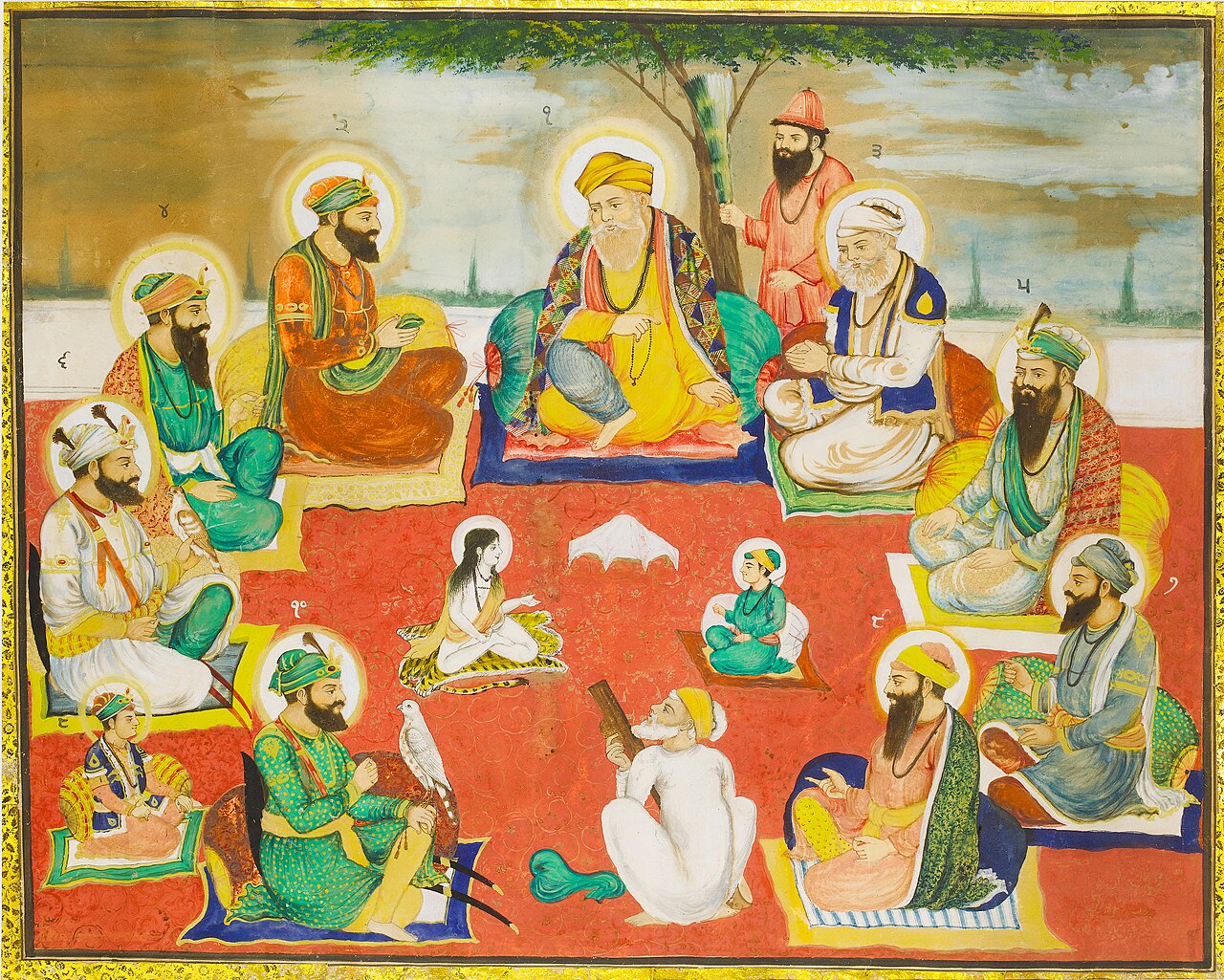
A short guide to each of the ten Sikh Gurus from Nanak to Gobind Singh, how succession actually worked, the rival claimants it produced, and the scholarly debate over the turn to arms.
In 1664 a Sikh trader named Makhan Shah, so the tradition says, arrived at the village of Bakala near the river Beas and found not one Guru but a crowd of them. The child Guru Har Krishan had died in Delhi, and his last words, “Baba Bakale”, had pointed his followers to this village. Some twenty-two claimants from the Guru’s extended family had set up seats there. Makhan Shah had once vowed five hundred gold coins to the Guru, so he laid two before each claimant and waited. Only one, a quiet great-uncle of the late Guru named Tegh Bahadur, asked about the rest of the promise. Makhan Shah is said to have climbed onto a roof and shouted that the true Guru had been found.
Whatever its details, the story poses a real question. Sikhi had ten human Gurus over nearly two and a half centuries, from Guru Nanak’s birth in 1469 to Guru Gobind Singh’s death in 1708. How did a community know who the Guru was, and what did it mean for the office to pass from one person to another?
One light in ten bodies
The earliest answer is inside the scripture. Two musicians at the court of the early Gurus, Satta and Balvand, composed a var (ballad) in Raag Ramkali that the Guru Granth Sahib preserves at Ang 966–968. It describes Guru Nanak installing his disciple Lehna under the royal canopy, and then states the principle that governs everything after: “They shared the One Light and the same way; the King just changed His body” (Ang 966, trans. Sant Singh Khalsa). The key words are jot, the light, and jugat, the way of living. Each Guru is not a new founder but the same Guru in a new body.
The scripture’s own labelling encodes this. The Gurus who composed hymns all signed them “Nanak”, and editors distinguish them with Mahala and a number: Mahala 1 is Nanak himself, Mahala 5 is the fifth Guru, Arjan. Only six Gurus have hymns in the Guru Granth Sahib; the sixth, seventh, eighth, and tenth added none. The mechanism of succession followed from the doctrine. The reigning Guru named a successor, often after tests of humility and service, and bowed to him. Birth did not decide it: Nanak passed over both his sons.
The first five: building a community (1469–1606)
Guru Nanak (1469–1539) taught remembrance of the divine Name, honest work, and sharing, and ended his life as a farmer-teacher at Kartarpur. Guru Angad (Guru 1539–1552), the renamed Lehna, moved the centre to Khadur. Sikh tradition credits him with standardising the Gurmukhi script and with organising the community kitchen that his wife, Mata Khivi, ran.
Guru Amar Das (Guru 1552–1574) was already seventy-three when he succeeded. At Goindval he built a stepwell (baoli) as a Sikh pilgrimage site and organised the scattered congregations under appointed leaders, the manji system, usually counted as twenty-two seats of authority. Tradition says that visitors, the emperor Akbar among them, ate in the langar before meeting him. Guru Ram Das (Guru 1574–1581), his son-in-law, founded the settlement of Ramdaspur around a pool that became the city of Amritsar.
Guru Arjan (Guru 1581–1606), youngest son of Ram Das, built the Harmandir at the centre of that pool and in 1604 compiled the Adi Granth, the first authorised volume of Sikh scripture. In 1606 he died in Mughal custody in Lahore under the emperor Jahangir, and Sikhs remember him as the first martyr Guru.
The last five: sovereignty and sacrifice (1606–1708)
Guru Hargobind (Guru 1606–1644), Arjan’s son, was still a boy when he succeeded. Sikh sources say he wore two swords, one for spiritual authority (piri) and one for temporal authority (miri), and he built the Akal Takht facing the Harmandir. He was held for a time in Gwalior fort, fought several skirmishes with Mughal forces, and spent his last decade at Kiratpur in the Shivalik foothills.
Guru Har Rai (Guru 1644–1661), a grandson of Hargobind, led a quieter period. When his elder son Ram Rai, sent to answer for the family at Aurangzeb’s court, altered a line of Guru Nanak’s to avoid offending the emperor, Har Rai disowned him and named his younger son instead. Guru Har Krishan (Guru 1661–1664) was five when he was installed. Summoned to Delhi, he died there of smallpox; Gurdwara Bangla Sahib marks the house where he stayed.
Guru Tegh Bahadur (Guru 1664–1675), the great-uncle found at Bakala, was Hargobind’s youngest son. He founded the settlement that became Anandpur and composed hymns later added to the scripture. In 1675 he was executed in Delhi on Aurangzeb’s orders; Gurdwara Sis Ganj stands at the site in Chandni Chowk. Sikh tradition connects his arrest to his stand on behalf of Kashmiri Brahmins facing forced conversion.
Guru Gobind Singh (Guru 1675–1708), his son, founded the Khalsa at Anandpur at Vaisakhi 1699, the initiated order whose members carry the Five Ks. He prepared the final recension of the scripture with his father’s hymns included. At Nanded in 1708, shortly before his death, he named no human successor and vested Guruship in the scripture, thereafter the Guru Granth Sahib, and in the Khalsa community, a pairing Sikhs call Guru Granth and Guru Panth.
Rival lines and disputed seats
Succession by designation had a weakness: every passed-over relative could become a rival. Nanak’s elder son Sri Chand, an ascetic, did not accept Angad’s authority, and the Udasi order of renunciants traces itself to him; Udasi mahants later looked after many gurdwaras until the reform movement of the 1920s. Prithi Chand, eldest son of Ram Das, contested his younger brother Arjan and set up a parallel lineage whose opponents called its followers Minas, a derogatory label from mainstream Sikh sources. Dhir Mal, Har Rai’s elder brother, kept an early manuscript of the scripture, and his descendants in Kartarpur still hold it. Ram Rai settled in the Garhwal hills at Dehradun, where the Darbar Sahib he founded still stands.
These divisions matter for reading the history. Many of the Gurus’ own actions, from Arjan’s compilation of an authorised scripture to Gobind Singh’s final decision in 1708, can be read partly as answers to the problem of counterfeit claimants. A single, closed text and an initiated body were far harder to usurp than a family seat.
A shift from saints to soldiers?
A common outside summary says Sikhi began as a peaceful devotional movement and turned militant under the sixth Guru. The tradition itself rejects any break: by the doctrine of one light, Hargobind’s two swords are Nanak’s teaching applied to a new situation, and Sikh writers point to Nanak’s own Babarvani hymns lamenting the violence of Babur’s invasion as evidence that the first Guru already spoke about political power.
Historians have argued the question in detail. In “The Evolution of the Sikh Community” (1976), W. H. McLeod proposed that the arming of the Panth owed much to the cultural patterns of the Jat peasants who had joined it in large numbers, together with growing conflict with the Mughal state. Critics pushed back. J. S. Grewal judged McLeod’s evidence too weak to sustain the thesis, and Pashaura Singh has argued that rural people were part of the community from Kartarpur onward, so there was no sudden influx to explain a sudden shift. Most accounts agree that Guru Arjan’s death in 1606 was a turning point in the Gurus’ relationship with Mughal power; they disagree about how far the response was set by doctrine, by circumstance, or by the social makeup of the followers.
Using the ten names
A list of ten Gurus is easy to memorise and easy to misunderstand as ten separate teachers. A better way to hold it is as one teaching tested in ten very different situations: a founding generation, an institution-building middle, and a century under growing imperial pressure.
A few practical habits help. When you read the scripture, watch the Mahala label, and notice that the voice signing “Nanak” may be the fifth or the ninth Guru; our guide to the Guru Granth Sahib explains the layout. When you visit Sikh sites, attach each to its Guru: Khadur and Goindval to the second and third, Amritsar to the fourth and fifth, Kiratpur to the sixth and seventh, Bangla Sahib and Sis Ganj in Delhi to the eighth and ninth, Anandpur and Nanded to the tenth. And when the question of authority comes up, remember that the story ends with a deliberate decision to stop naming human Gurus, a choice explored in our piece on teachers and discernment. For the first Guru’s teaching in full, start with Guru Nanak’s message.