
Jainism
The 24 Tirthankaras: Who They Are and How Jains Relate to Them
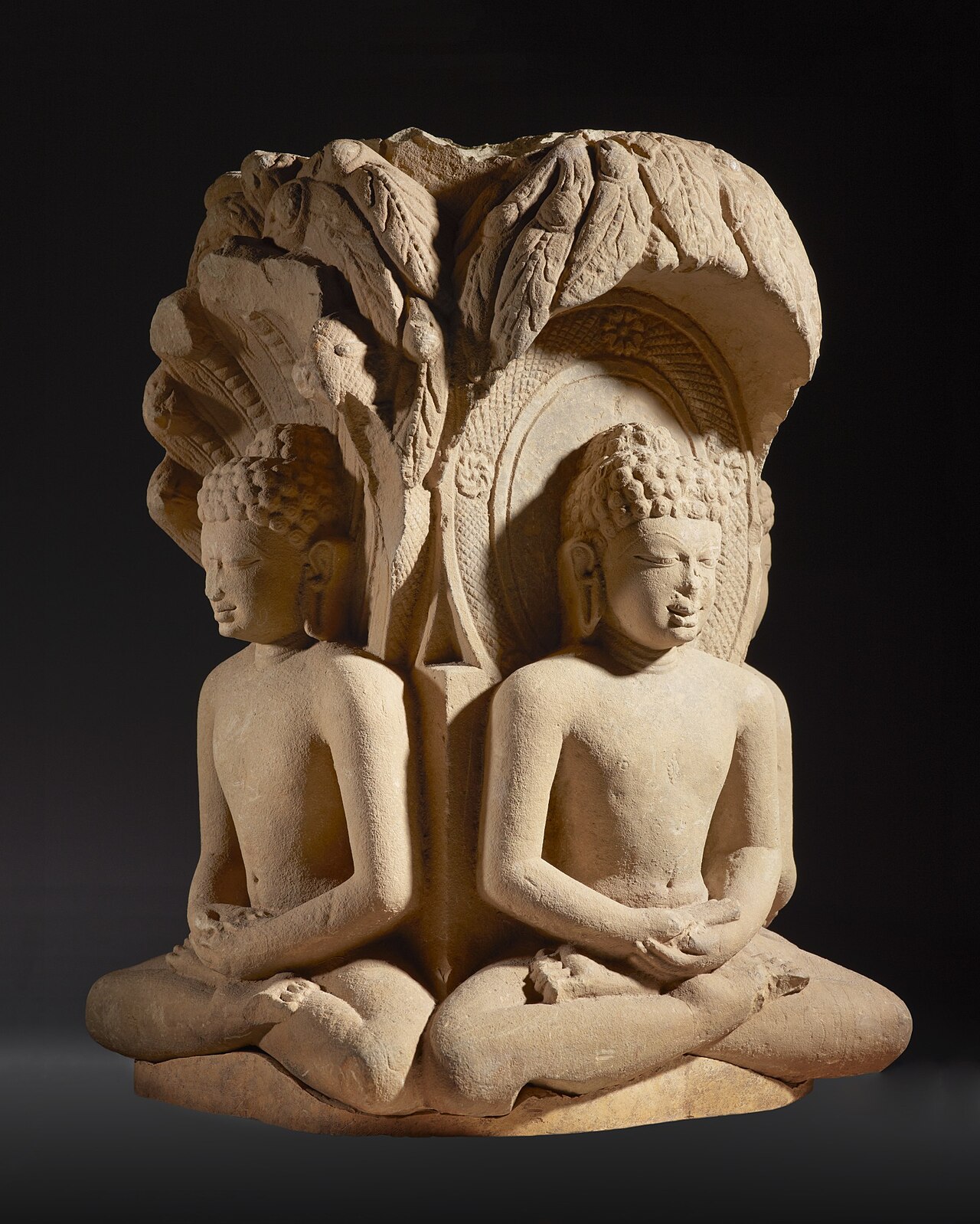
What a Tirthankara is, why there are exactly twenty-four in each half of the Jain time cycle, how to tell their images apart, and why Jains worship teachers who can no longer answer.
Almost every Jain temple holds a row of figures that look, at first glance, identical. Each sits cross-legged or stands upright with arms hanging straight down, eyes lowered, face serene and unreadable. There is no drama in these images: no weapons, no consorts, no raised hand of blessing. A newcomer may reasonably wonder who they are and why there are so many. The answer is one of the most distinctive ideas in Indian religion, the Tirthankara.
The ford and the ford-maker
A tirtha is a ford, a shallow place where a river can be crossed on foot. In Jain thought the river is samsara, the endless round of birth and death driven by karma. A Tirthankara is a “ford-maker”: a human being who crosses that river, reaches omniscience (kevala jnana), and then teaches others how to cross. The word tirtha also names what the Tirthankara leaves behind, the fourfold community of monks, nuns, laymen and laywomen who carry the teaching forward.
Two other titles appear alongside it. A Tirthankara is a Jina, a “victor”, because he has conquered attachment and aversion (raga and dvesha); the word Jain means a follower of the Jinas. While still alive and teaching, a Jina is also an Arihant, “one who has destroyed the inner enemies”. That is why the Navkar Mantra, the most widely recited Jain prayer, shared by all sects, opens with Namo Arihantanam, homage to the Arihants, before it honours the fully liberated souls (siddhas). The order is deliberate: the Arihant is honoured first because only a living teacher could show the way.
Why twenty-four, and why again and again
Jain cosmology imagines time as a wheel that turns forever through two half-cycles. In the descending half (avasarpini), human life, height, virtue and happiness steadily decline; in the ascending half (utsarpini) they recover. Each half-cycle has exactly twenty-four Tirthankaras. In our own descending age the sequence began with Rishabhanatha (also called Adinatha), whom Jain tradition credits with teaching humanity farming, crafts and social order, and ended with Vardhamana Mahavira.
This framework matters for a basic point that outsiders often miss: Jains do not regard Mahavira as the founder of their religion. He is the twenty-fourth teacher to rediscover and re-proclaim a truth that is eternal and uncreated. The Tirthankaras do not invent the path; they find it again after it has been forgotten.
Jain cosmology also places other regions of the universe, above all Mahavideha, where Tirthankaras are always present and teaching. Devotion to one of them, Simandhara Swami, is important to several modern Jain movements, precisely because he is understood to be alive and preaching now, even if he cannot be reached from our world.
Telling the Jinas apart
Because every Tirthankara has achieved the same perfection, their images share the same idealised form. They sit in the lotus posture (padmasana) or stand in the “abandoning the body” posture (kayotsarga), a pose of complete stillness. Digambara images are carved unclothed, reflecting that tradition’s ideal of total non-possession; Svetambara images are often adorned in worship with inlaid eyes, crowns and ornaments. (For the history behind that difference, see our guide to Digambara and Svetambara communities.)
The practical way to identify a Jina is his emblem (lanchana), usually carved small on the pedestal. Rishabhanatha’s is the bull, Neminatha’s the conch shell, and Mahavira’s the lion. Two figures can also be recognised from the image itself: Parshvanatha sits sheltered by the spread hoods of a many-headed serpent, and Rishabhanatha is often shown with locks of hair falling to his shoulders.
Tradition gives every Tirthankara the same five great events, the panca kalyanaka: conception, birth, renunciation, omniscience and final liberation. His mother sees a series of auspicious dreams on the night he is conceived. Svetambara texts count fourteen dreams, and Digambara texts give a different count. In the Kalpa Sutra’s account of Mahavira, his mother Trishala first sees an elephant, a bull and a lion; in Rishabha’s story, his mother Marudevi sees the bull first. After omniscience the gods build a samavasarana, a tiered assembly hall in which humans, gods and animals all hear the sermon, each in a form they can understand. The Svetambara Kalpa Sutra, recited by monks every year during Paryushana, tells these stories for Mahavira, Parshva, Arishtanemi and Rishabha.
Both Svetambaras and Digambaras place the final liberation of twenty of the twenty-four at Sammed Shikhar, the hill in Jharkhand that is among the most important Jain pilgrimage sites.
History and tradition
Scholars read the list of twenty-four in two layers. The earlier Tirthankaras belong to a mythic time scale: tradition gives them lifespans and heights far beyond anything human, and historians treat them as sacred figures rather than datable people. The last two are different. Mahavira, traditionally dated 599 to 527 BCE and placed somewhat later by many modern historians, was a contemporary of the Buddha, and early Buddhist texts mention him under the name Nigantha Nataputta. Most historians, Paul Dundas among them, also accept Parshva as a real teacher. Jain tradition places his liberation 250 years before Mahavira’s, and the Uttaradhyayana Sutra (lecture 23, the dialogue of Keshi and Gautama) records a meeting between their followers in which Parshva’s Law “recognises but four vows” while Mahavira’s “enjoins five”, the origin of the five great vows Jains keep today. Dundas notes that the real interval between the two teachers may have been much shorter than the traditional 250 years.
Between myth and history stand the stories that give the Tirthankaras individual character. The Uttaradhyayana Sutra (lecture 22) tells how Arishtanemi, the twenty-second, on the way to his own wedding saw animals shut in cages and enclosures, overcome by fear, and learned they were to be killed for the wedding feast. Unwilling that living beings should die for his sake, he gave his ornaments to his charioteer and renounced the world on Mount Raivataka (Girnar). Jain tradition makes him a cousin of Krishna, which weaves the Jain story into the same epic world that Hindus know from the Mahabharata.
The nineteenth Tirthankara, Malli, shows how the list can also be a place of disagreement. Svetambaras hold that Malli was a woman and cite her as proof that women can attain liberation. Digambaras hold that Mallinatha was a man, since in their view the complete renunciation required for liberation, including nudity, is not open to women in this lifetime. Padmanabh Jaini’s Gender and Salvation traces this debate across centuries of texts. It is one of the clearest cases where the two traditions read the same sacred history in opposite ways.
Worshipping someone who cannot answer
The most common misunderstanding about the Tirthankaras is that they are gods who grant wishes. In Jain doctrine a liberated Jina is vitaraga, free of all attachment, and dwells at the summit of the universe in perfect knowledge and bliss. He does not hear prayers, reward devotion or punish neglect, because responding would require exactly the attachment he has overcome.
The anthropologist Lawrence Babb built his study of Jain ritual in Jaipur, Absent Lord, around this puzzle: what does it mean to worship a being who is entirely beyond the reach of worship? The Jain answer is that the benefit flows from the worshipper’s own act. Bathing an image, offering rice, flowers and lamps, or simply gazing at the still face of the Jina is a way of turning the mind toward the qualities he embodies: detachment, restraint and clarity. The offerings are given up, not traded. Worldly needs such as health, children or success in business are usually brought to other figures: guardian deities like Padmavati and Dharanendra, who protect Parshvanatha in his story, or, in Babb’s Jaipur, the Dadagurus, deified monks of the Khartar Gacch lineage who, unlike the Jinas, are believed able to respond.
This is not a contradiction so much as a division of labour. The Jina stays pure, and the Jain world makes room elsewhere for everyday hope.
Why the ford-makers still matter
For a modern reader the Tirthankara model offers an unusual kind of exemplar. He is not a saviour who carries you across, but a guide who proves the river can be crossed and marks where the footing is firm. The responsibility for crossing stays with each person. That is why Jain ethics puts such weight on carefulness in ordinary life, why its philosophy of many-sidedness warns against confusing a partial view with the whole, and why its greatest figures are honoured for what they gave up rather than what they can give.
The next time you stand in front of a row of identical Jinas, look down at the pedestals. The bull, the conch, the serpent and the lion each mark a different life, a different era and the same crossing.