
Jainism
The Life of Mahavira: How Svetambara and Digambara Sources Tell It
What the Acaranga Sutra, the Kalpa Sutra, and later Digambara biographies say about Mahavira's life, where the two Jain traditions agree, where they part, and why their differences follow doctrine.
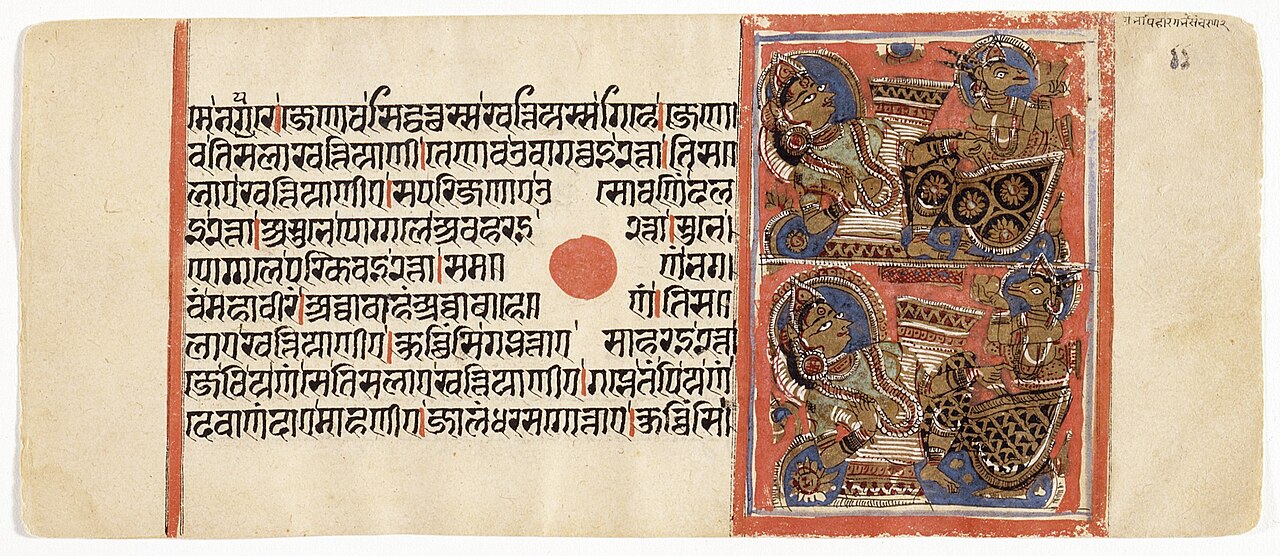
On a small painted page from fifteenth-century Gujarat, now in the Los Angeles County Museum of Art, two panels sit one above the other. In the upper one, a small divine figure takes something from a reclining woman; in the lower, he brings it to a second woman. The figure is Harinaigamesin, commander of the god Shakra’s foot soldiers. The first woman is Devananda, wife of the Brahmin Rishabhadatta; the second is Queen Trishala; and what he carries from one to the other is the embryo of Mahavira, the twenty-fourth Tirthankara. Scenes like this fill Svetambara manuscripts of the Kalpa Sutra, which monks still read aloud every year during Paryushana.
A Digambara Jain looking at the same page would say that it never happened. The two great Jain traditions revere the same teacher and agree on the outline of his life, yet they tell that life differently at several points. The differences are not random. Almost every one of them lines up with a doctrinal dispute, which makes Mahavira’s biography one of the clearest places to see how the Digambara and Svetambara traditions think.
Two shelves of sources
Svetambara Jains draw Mahavira’s life from their canon in Ardhamagadhi Prakrit. The oldest layer is a single lecture in the first book of the Acaranga Sutra, the one Hermann Jacobi translated as “The Pillow of Righteousness” (Book 1, Lecture 8 in his numbering). It is a spare portrait of an ascetic: no dreams, no embryo transfer, no family history, only a man who walks, fasts, meditates, and endures. The second book of the Acaranga (Lecture 15) and the Kalpa Sutra, traditionally attributed to the elder Bhadrabahu, supply the fuller story: family names, exact dates, and, in the Kalpa Sutra, the mother’s dreams.
Digambaras hold that the ancient canon was lost in the centuries after Mahavira, so they do not treat these texts as authoritative. Their versions of his life come from later Sanskrit works composed by their own teachers. Asaga’s Vardhamanacarita, an eighteen-canto poem written in 853 CE, is the earliest surviving Sanskrit biography of Mahavira. The Uttarapurana, completed by Gunabhadra after the death of his teacher Jinasena as the second half of their Mahapurana, tells Mahavira’s life among those of the later Tirthankaras.
There is also an outside witness. The Buddhist Pali canon mentions a rival teacher called Nigantha Nataputta, and scholars identify him with Mahavira. The Pasadika Sutta (Digha Nikaya 29) opens with news that Nataputta has recently died at Pava and that his followers have fallen into quarrelling. It is a hostile report, but it agrees with Jain sources in naming Pava as the place of his death (where ancient Pava lay is itself debated).
The shared outline
Stripped to its common frame, the story runs as follows. Vardhamana was born into a Kshatriya family in the region the Kalpa Sutra calls Videha, in present-day Bihar; his father Siddhartha belonged to the Kashyapa clan and his mother was Trishala. The Kalpa Sutra explains the name: from the moment the child was conceived, his parents said, “our silver increased, our gold increased”, so he was called Vardhamana, “the increasing one”. The same text notes that the title Mahavira, “great hero”, was given to him by the gods for his steadfastness. According to the Acaranga, his parents were followers of Parshva, the twenty-third Tirthankara, so the boy grew up inside an existing ascetic tradition rather than inventing one, a point explored in our guide to the 24 Tirthankaras.
At about thirty he renounced household life. More than twelve years of wandering followed, and the Acaranga does not soften them. In the country of the Ladhas, it records, villagers struck him and set dogs on him, and “It is difficult to travel in Ladha”. In the thirteenth year, according to the Kalpa Sutra, he attained kevala jnana, omniscience, while meditating in a squatting posture under a sal tree on the bank of the river Rijupalika, outside the town of Jrimbhikagrama. He then taught for some thirty years and died at Pava at the age of seventy-two. Jain tradition conventionally dates his life to 599 to 527 BCE, while many historians place him somewhat later, as a contemporary of the Buddha.
Where the stories part
Conception. The Kalpa Sutra says Mahavira was first conceived in the womb of the Brahmin woman Devananda. Shakra, king of the gods, reflected that Tirthankaras are born only into royal or noble Kshatriya families, and sent Harinaigamesin to exchange the embryo with the one in Trishala’s womb on the eighty-third day. Digambaras reject this episode: in their account Trishala conceived him from the start. Even the number of Trishala’s dreams differs. Svetambara texts list fourteen auspicious dreams; Digambara texts list sixteen, including a pair of fish and a throne.
Marriage. Svetambara sources say Mahavira married a princess, Yashoda, and had a daughter, known as Anojja or Priyadarshana. Digambaras hold that he refused marriage and renounced as a celibate young man.
Clothing. Here the oldest Svetambara layer is explicit. The Acaranga says: “For a year and a month he did not leave off his robe. Since that time the Venerable One, giving up his robe, was a naked, world-relinquishing, houseless (sage).” In Digambara accounts he abandoned clothing, along with his ornaments, at the moment of renunciation.
Life after omniscience. Svetambaras hold that a kevalin, an omniscient being, still has a body with ordinary needs: he eats, travels, and preaches. Their canon, in the Bhagavati Sutra, even records that the former disciple Gosala, leader of the rival Ajivika order, attacked Mahavira with a burst of fiery ascetic power that left him ill for months, until a laywoman named Revati supplied a cooked preparation that restored him. Digambaras teach that a kevalin is free of hunger and illness and does not speak in the ordinary way; instead a divine sound (divyadhvani) issues from his body, which his followers interpret as the teaching.
Not a contest over trivia
It is easy to treat these divergences as folklore, pleasant variant details that sectarian pride has blown out of proportion. That reading misses what each tradition is doing. The biography of a Tirthankara is not only a record of the past; it is a demonstration of what liberation requires, and each community tells the life in the form its doctrine needs.
The clearest case is clothing. Digambara teaching holds that complete nudity is a condition of the highest renunciation, so that a monk who keeps even a cloth has not fully let go of possession. A Mahavira who wore a robe for thirteen months would undercut that claim at its source. For Svetambaras, whose monks and nuns wear white cloth, the robe episode shows that clothing is not in itself a barrier to the path. The same logic runs through the kevalin debate. If omniscience means the end of every bodily weakness, as Digambaras argue, then a Mahavira who fell ill and needed food is impossible, and the Gosala story cannot stand as Svetambaras tell it. If the karmas that govern the body remain in force until death, as Svetambaras argue, even after the karmas that obscure knowledge are gone, there is nothing scandalous in a Jina who eats.
The embryo transfer is less clearly tied to a single debate. The reason the Kalpa Sutra itself gives is one of pattern: a Tirthankara’s birth must take place in a royal or noble family, and when karma produces an exception, the gods intervene to restore the pattern. Digambara biographies contain no such episode.
None of this means either tradition is inventing freely. Both keep the same frame: the same parents, the same name, the same years of austerity, the same death at Pava. Where they diverge, each is reading the life through a coherent set of commitments, and each has argued for its position in writing for many centuries.
Reading a life of Mahavira today
Popular retellings of Mahavira’s life, in print and online, can blend the two traditions without saying so: the fourteen dreams from one, a celibate hero from the other. When you read one, it is worth asking which tradition a detail comes from. The answer is usually easy to find: a married Mahavira, a robe kept for thirteen months, or an embryo carried by Harinaigamesin marks a Svetambara source, while sixteen dreams, an unmarried prince, and the divine sound mark a Digambara one.
If you attend a Paryushana reading of the Kalpa Sutra, you are hearing one tradition’s account, not the whole of Jain memory. Listening with that in mind is a small exercise in the habit Jains call anekantavada: each community holds a real part of the story, and neither needs the other to be wrong about everything in order to be right about something. For a first primary text, the lecture Jacobi called “The Pillow of Righteousness” can be read in one sitting and gives the oldest surviving picture of Mahavira, before either tradition filled in the rest of his story.